Over-servicing is the quietest way an agency loses money. Nobody decides to give away eleven hours. It accumulates in half-hour pieces, each one too small to be worth a conversation, until a retainer that looked healthy in the proposal is running at a margin you would never have signed. The standard advice is to track your time better. Time tracking is useful, and it will not find this.
What does over-servicing actually look like?
Twenty small favours, not one big one. A logo resized for a channel nobody mentioned, an extra round on a deck, a call that was not in the plan, an afternoon chasing someone else's legal team. Each is defensible on its own. Together they are a week of somebody's month, unbilled and unrecorded.
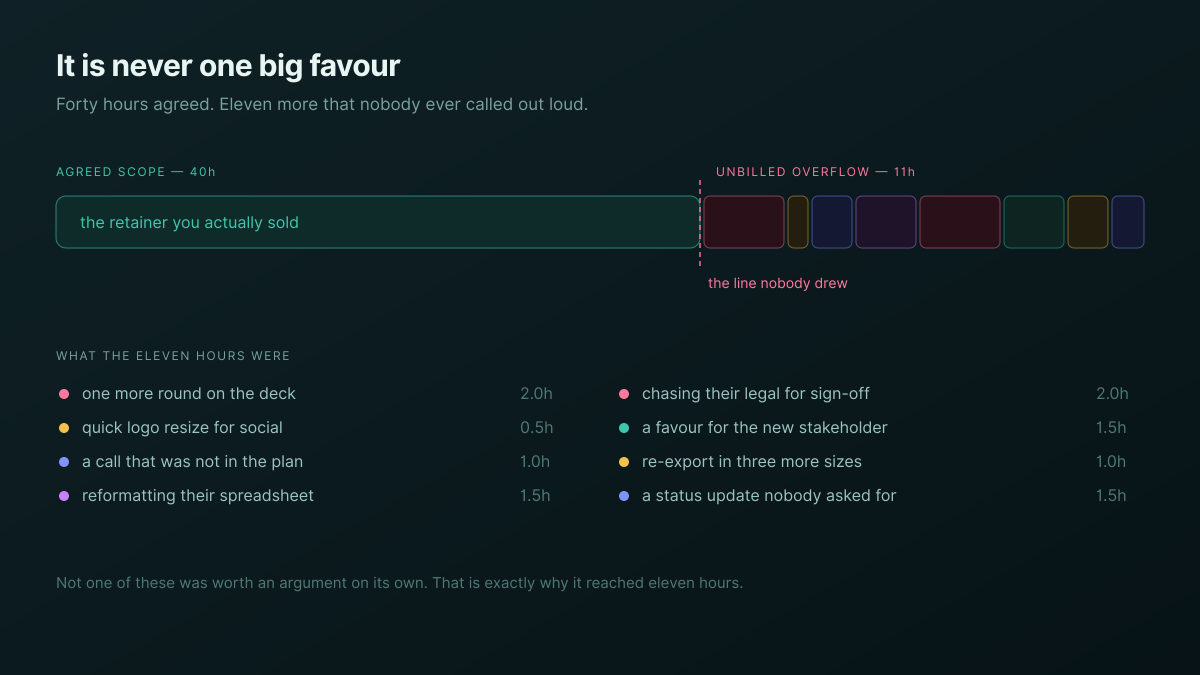
The reason it survives is that no single item is worth the friction of raising it. Refusing to resize a logo makes you look difficult over thirty minutes. That calculation is correct every time you make it, and it is still how the eleven hours happen.
Why doesn't time tracking catch it?
Because hours spent and scope are two different questions, and a timesheet only answers the first. It can tell you forty-eight hours went to this client. It cannot tell you that eleven of them were work you never agreed to do, because nothing in a timesheet knows what you agreed to.
There is a second problem underneath it. Timesheets are filled in at the end of a day or a week, from memory, rounded to the nearest half hour. The half-hour favour is exactly the entry that gets absorbed into a bigger one or forgotten, so the instrument is least accurate precisely where you need it most.
| Dimension | A timesheet alone | Atwork |
|---|---|---|
| What gets recorded | Hours against a client | Hours against a specific request |
| Knows what you agreed to | No | Yes, when scope is a field on the item |
| When you find out | At month end | When the work arrives |
| Still needs a person to log it | Yes | Yes — no tool fixes this |
None of that makes time tracking wrong. It answers the profitability question well, and how to tell if a retainer is actually profitable is the arithmetic that depends on it. It is the wrong instrument for this particular question, which is a different thing from being a bad instrument.
What has to be written down before you can measure it?
The scope, per retainer, attached to the work rather than filed as a signed PDF. In Atwork that means the deliverables are rows and each one carries what it covers, so whether something is included becomes a field you can read instead of a memory you have to trust.
Four things are worth the effort of writing down. Most agencies have the first and none of the rest.
- The deliverables, named. Not "social media management" but the specific artefacts you produce and how often.
- The quantity. Two rounds, not "revisions". An uncounted noun is an unlimited one, and clients read it that way honestly rather than cynically.
- What is explicitly excluded. The exclusions do more work than the inclusions, because the argument is never about the thing you listed.
- Who can authorise extra work. If three people at the client can ask and nobody can approve, every request arrives as a favour.
This is ordinary commercial hygiene and it pays off whether or not you ever measure anything. The measurement just makes skipping it expensive.
How do you tell in-scope from out-of-scope on a live board?
Tag it when the request arrives, not at month end. One field on the item with three values — in scope, out of scope, ours — set by whoever picks the work up. It takes ten seconds, and it is the only moment when everybody still remembers what was agreed.
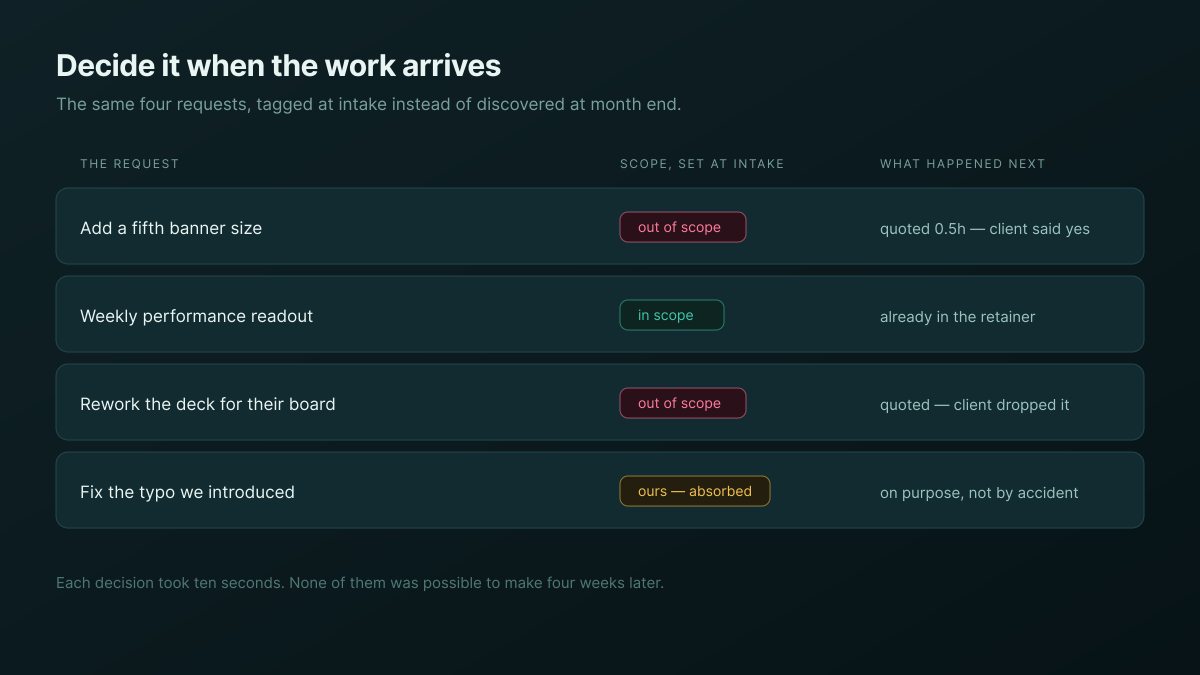
The third value is the one people leave out, and it is the one that makes the other two believable. Not everything extra is billable: fixing a typo you introduced is yours, and it should be recorded as absorbed on purpose rather than quietly folded into the retainer. A team that can mark work as ours will trust the out-of-scope tag, because it is clearly not a device for billing clients for your own mistakes.
When do you have the conversation?
Week two, not month six. The cost of waiting is not the hours you lose in the meantime — it is that repetition converts a favour into an expectation, and an expectation is far harder to reset than an invoice is to send.
Nobody argues about the first extra round. They argue about the eleventh, because by then it is not a favour, it is the deal.
The conversation is also easier than it sounds when you have the record. You are not asking the client to accept a claim about how hard you worked; you are showing them four requests, when each arrived, and what each one cost. Most reasonable clients did not know. The ones who did know were relying on you not to have noticed, and now you have.
If the monthly report is where this surfaces, what to put in a monthly client report covers how to say it without it reading as a complaint, and status updates without the weekly call covers the cadence that keeps it from piling up.
What do you do about a client who is already over-serviced?
Four options, and three of them are better than the one most agencies pick.
| Option | What it costs you |
|---|---|
| Absorb it, deliberately | Margin — acceptable only with a stated reason and an end date |
| Re-scope to what you actually do | One awkward conversation; usually the right answer |
| Raise the retainer to match reality | The risk they decline, which is information you needed |
| End the engagement | Revenue, and the relief is usually immediate |
The option not in the table is to keep going and hope it improves. It does not improve, because nothing about the current arrangement is applying pressure in that direction. Whichever of the four you choose, choosing is the part that changes the outcome.
If the underlying problem is that the team is simply booked past what it can deliver, that is a capacity question rather than a scope one — agency capacity planning is the companion piece, and managing agency freelancers covers the overflow route.
Where should you start this week?
Pick your least profitable retainer and write down what is excluded from it. Not the inclusions — you already have those, and they are not what the arguments are about. One list of exclusions, one sentence each, and send it to nobody.
Then tag every request that arrives for two weeks as in scope, out of scope, or ours. Do not change how you work, do not refuse anything, do not raise it with the client. Just record it. At the end of two weeks you will have the number, and the number is the whole argument — with the client, and with yourself about whether this account is worth keeping as it stands.
The Agency Client Delivery template ships the sheets this runs on, and the agencies overview covers the wider setup.
Write down what your worst retainer excludes, then tag every request for two weeks. The number will make the decision for you. Start free