Every agency owner has had the same Tuesday. Everyone looks slammed, two people have mentioned being underwater, a project is slipping, and the obvious conclusion is that you need to hire.
Sometimes that is right. Often the same numbers support a completely different answer, and the only way to tell is to separate three things most capacity spreadsheets mash together: how much work is planned, how much of it is real, and how much the team can actually absorb.
Why does everyone feel busy even when there is capacity?
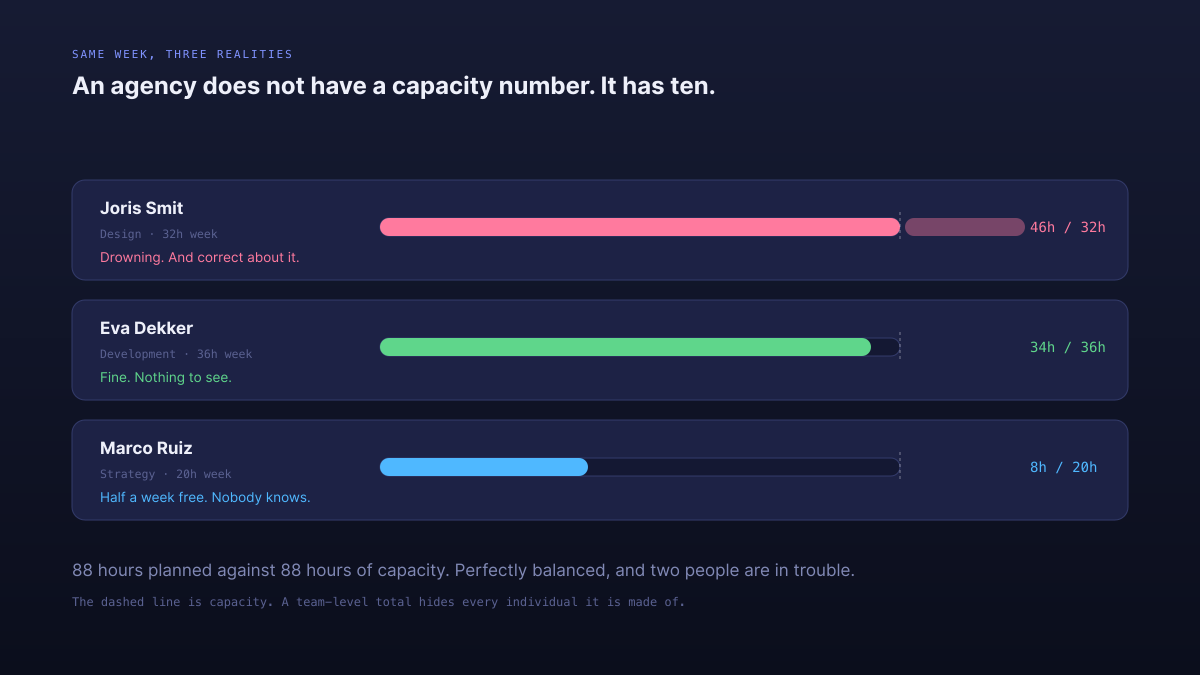
Because busyness is distributed unevenly and felt individually. Your designer at 46 hours against a 32-hour week is genuinely drowning. Your strategist at 8 hours against 20 is not, and has no idea the designer is drowning. Both are telling you the truth about their own week.
An agency of ten does not have a capacity number. It has ten of them, and the average is the least useful summary of the set.
What are the three numbers that decide it?
Planned hours, certainty, and capacity. Most agencies track the first, guess at the third, and never write down the second at all.
- Planned hours — what you have allocated, per person, per week.
- Certainty — whether that work is actually going to happen.
- Capacity — what that person can genuinely absorb in a week, which is not the number on their contract.
Capacity is where the self-deception starts. A full-time employee does not have 40 billable hours. Once internal reviews, pitch support and the general friction of the week are subtracted, 32 is honest for most people. Planning against 40 guarantees an overload you then treat as a surprise.
What does certainty mean, and why does it decide the hire?
Certainty is whether a planned hour is going to happen. Three states are enough:
- Confirmed — signed, dated, staffed.
- Likely — verbal yes, contract pending.
- Speculative — proposal out, no answer.
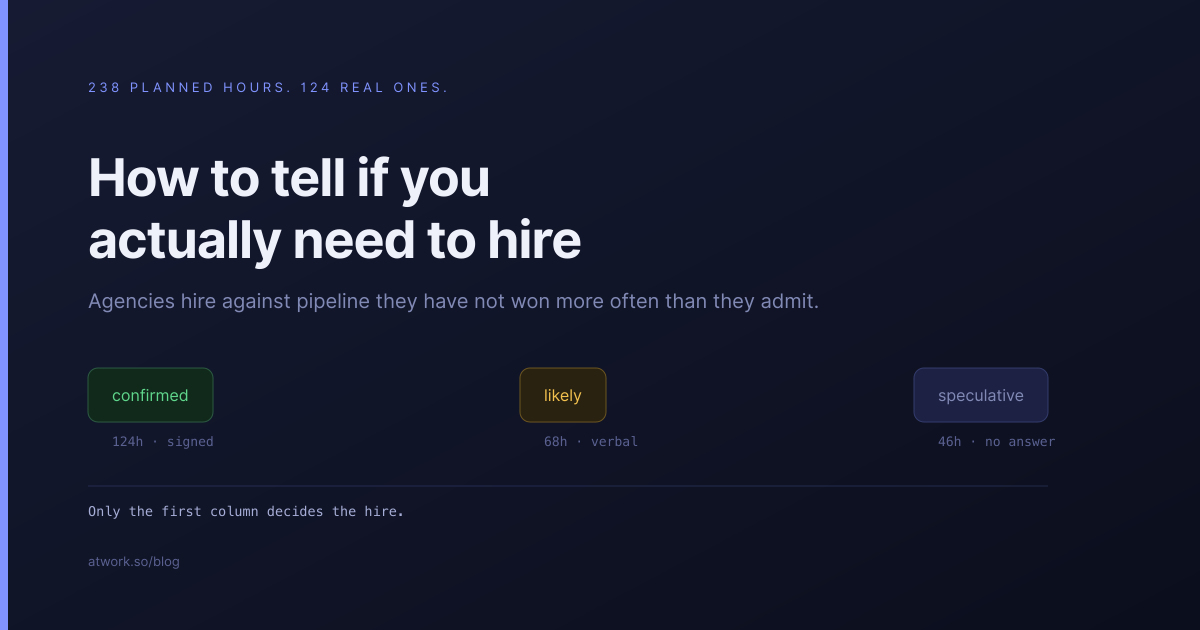
Here is the whole argument for writing it down. Say you are looking at 238 planned design hours over the next month against a bench that can do 128. That is a hire, obviously.
Except 46 of those hours are a rebrand pitch you have not won and 68 are a verbal yes with no contract. Your Confirmed demand is 124 hours against 128 of capacity. You do not need to hire. You need the pitch to close, and if it does you need a freelancer for six weeks while you find out whether the work sustains.
Agencies hire against pipeline that has not closed at least as often as they under-hire against real work. Without a certainty column the two look identical.
When is it actually a hire?
When Confirmed demand exceeds capacity for a sustained period, in a discipline you keep buying in, and the freelance version is costing you more than a salary would.
Three tests, all of which should pass:
- Sustained — three months or more, not one bad fortnight. A single overloaded week is a scheduling problem.
- Confirmed — measured against signed work, never against the pipeline.
- Repeatedly bought in — if you are hiring the same freelance discipline every month at a day rate, you are already paying for the role, just less efficiently and with less loyalty.
If any one fails, the answer is usually a freelancer, a moved deadline, or a rebalance — and those are reversible in a way a hire is not.
What do you do with an overbooked week?
Treat it as a decision with an owner, not a fact you noticed. There are four legitimate answers and one bad one.
- Rebalance — move work between people or weeks. Cheapest, and usually possible if you look early enough.
- Bring in a freelancer — right when the overload is real and short.
- Move the deadline — unpopular and frequently correct. A date moved three weeks out is a conversation; a date missed is a failure.
- Accept it — deliberately, with the person, for a defined period. A hard week everyone chose is very different from a hard week that happened.
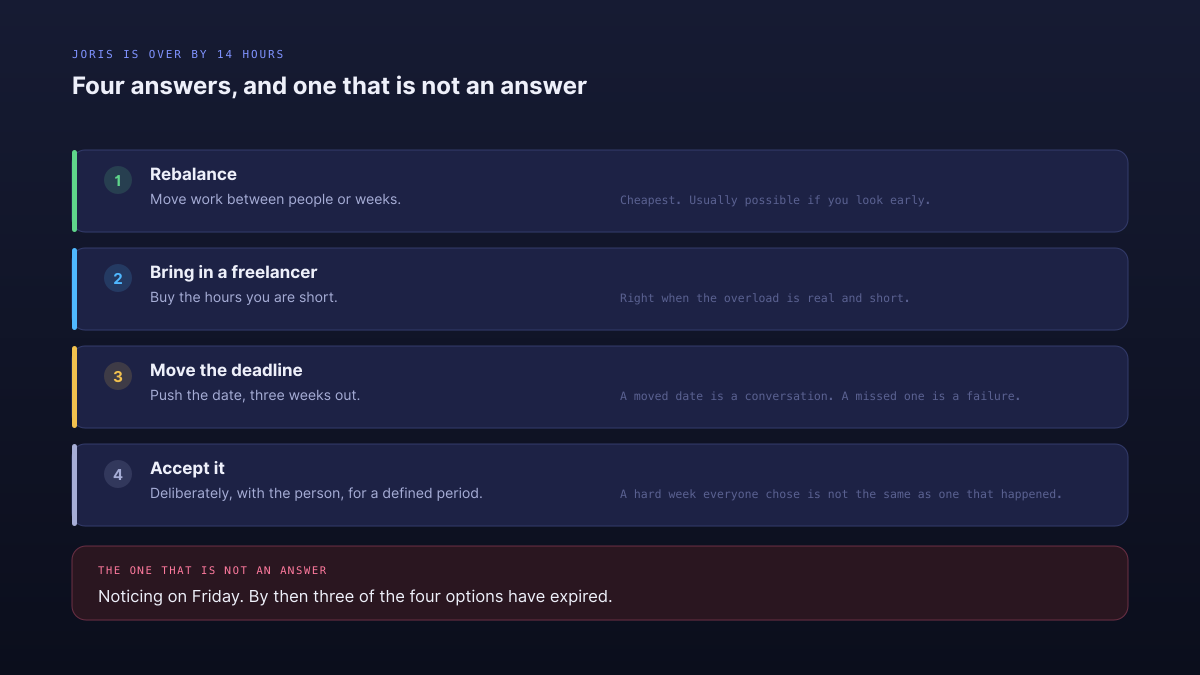
The bad answer is noticing on Friday. By then three of the four options have expired.
How far ahead should you plan?
One week properly beats a quarter badly.
Weekly is where the decisions actually live: this is the horizon at which you can still rebalance, still call a freelancer, still move a date without a difficult conversation. Quarterly plans are useful for hiring conversations and useless for staffing, because everything past about three weeks is a mix of Likely and Speculative that will change.
Plan the week in detail, hold the quarter loosely, and be honest that the difference between them is certainty rather than effort.
What does this look like in Atwork?
The Agency Resource Planning template is built around exactly these columns.
- Allocations — planned hours per person per week, each tagged Confirmed, Likely or Speculative.
- People — weekly capacity and employment type, so a part-timer's 20 hours stays 20.
- Capacity Flags — a task sheet for Overbooked, Underused and Key-person risk, each carrying a Resolution: Rebalanced, Hired freelancer, Moved deadline or Accepted.
- Dashboards — hours by certainty and by discipline against capacity by discipline.
There is no formula computing utilisation for you. The dashboards put planned hours and capacity side by side and the comparison is yours to make, which takes ten seconds and is the ten seconds worth doing yourself.
If the question underneath capacity is really margin, how to tell if a retainer is actually profitable is the arithmetic, and managing freelancers covers the bench you reach for when a flag says Overbooked.
Before your next hiring conversation, split your planned hours into Confirmed, Likely and Speculative and look only at the first column. The answer is frequently different, and it is always cheaper to find that out now.
Tag next week's allocations with a certainty, then compare Confirmed hours to capacity. That number decides the hire. Start free