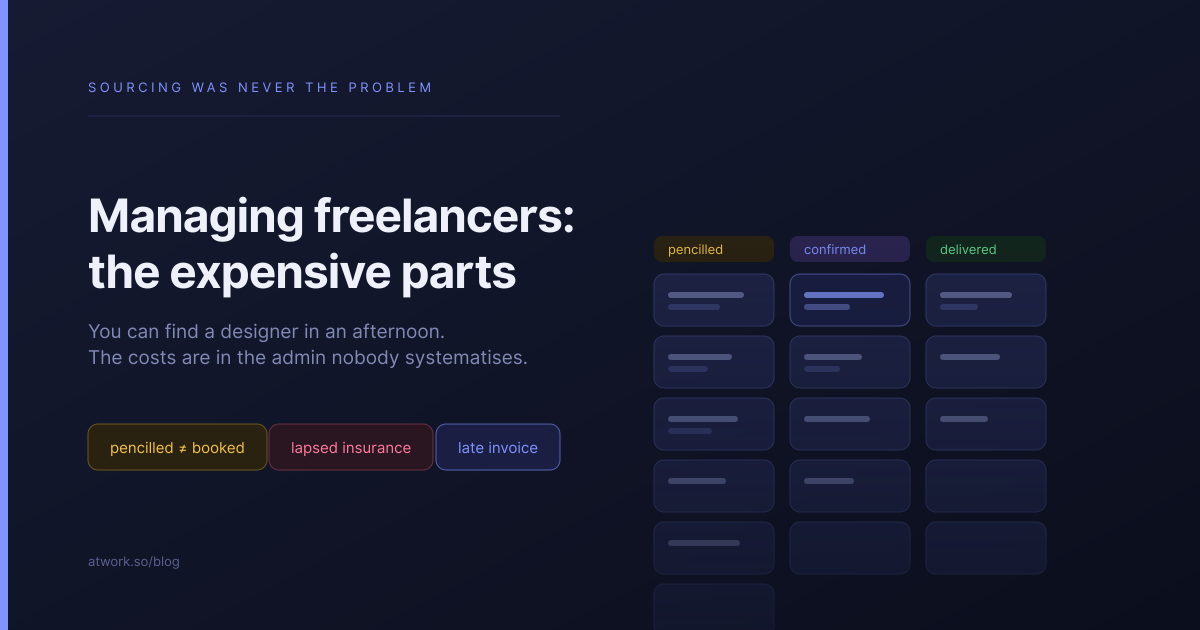
Every agency I have worked with can find a freelancer in an afternoon. There is a designer in a Slack group, a developer someone worked with last year, a directory of motion people. Sourcing is not the problem, and it never was.
The costs sit in four unglamorous places: the booking you thought was confirmed, the document nobody chased, the rate that drifted, and the invoice that arrived three months late against a project you had already reported on.
Why is finding freelancers the easy part?
Because supply is genuinely abundant and the internet solved it. What the internet did not solve is the administration that starts the moment someone says yes — and that administration is invisible until it fails, which is why it never gets a system.
The tell is that most agencies track freelancers in a spreadsheet of names and rates. Names and rates are the two facts least likely to cause a problem.
What is the difference between pencilled and confirmed?
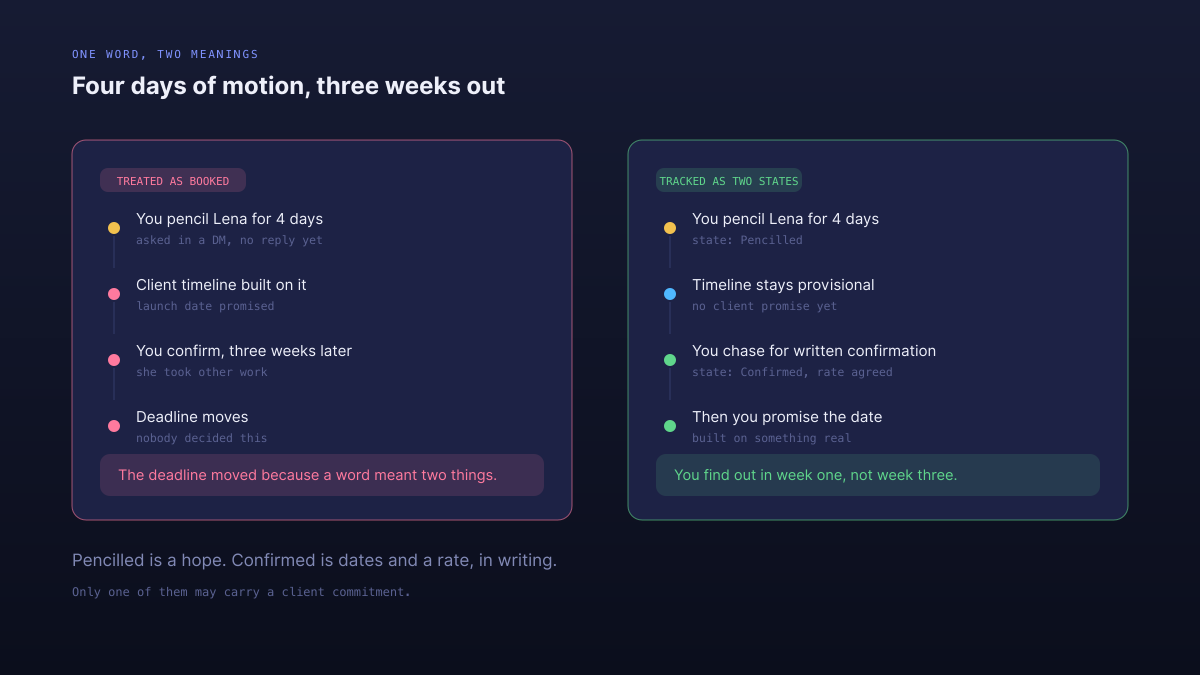
A pencilled freelancer is a hope. A confirmed one has agreed, in writing, to specific days at a specific rate.
Collapsing the two is the single most common scheduling failure in agency delivery. It goes like this: you pencil a motion designer for four days in three weeks, you build the client timeline around those days, and when you finally confirm, they took other work. Nobody made a decision to move your deadline. It moved because a word in your head meant two different things.
- Pencilled — you have asked, or they have expressed interest. Plan around it at your own risk.
- Confirmed — dates and rate agreed in writing. This is the only state you may build a client commitment on.
Two words in a column, and a category of failure disappears.
What paperwork actually matters, and when does it bite?
Four documents, and each one bites at a different and predictable moment.
- The contract bites at the dispute. Usually months in, usually about IP or a missed deadline, always when the person has already been paid.
- The NDA bites when a client asks who has access to their data. You want the answer to be a filter, not a search of your email.
- Insurance bites when something goes wrong on a client's site or premises. This is the one that turns an incident into your liability.
- The tax form bites at year end, when finance discovers a contractor with no paperwork and your accountant asks a question with no good answer.
None of these is urgent on the day you book someone, which is exactly why they get skipped. Make them states — On file, Expiring, Missing — and the skip becomes visible.
Who should own the freelancer relationship?
One person, named, for each freelancer. Not the team.
When three account leads book the same designer independently, you get three different day rates, three different briefing styles and a freelancer who reasonably plays them off against each other. It also means nobody notices they have quietly become a full-time cost with none of the commitment on either side.
The owner does not have to do the booking. They have to be the person whose number the freelancer has, and the person who notices when something is off.
How should you handle rates?
Keep a standing day rate on the person, and the agreed rate on the booking.
Those are different numbers more often than agencies expect. Rates get negotiated per job — a rush job, a long engagement, a client you both want. If you only store one, you either lose the history or you keep overwriting the record of what you actually agreed.
The booking is what you will be invoiced against, so the booking is where the agreed rate belongs.
What about the invoice that never arrives?
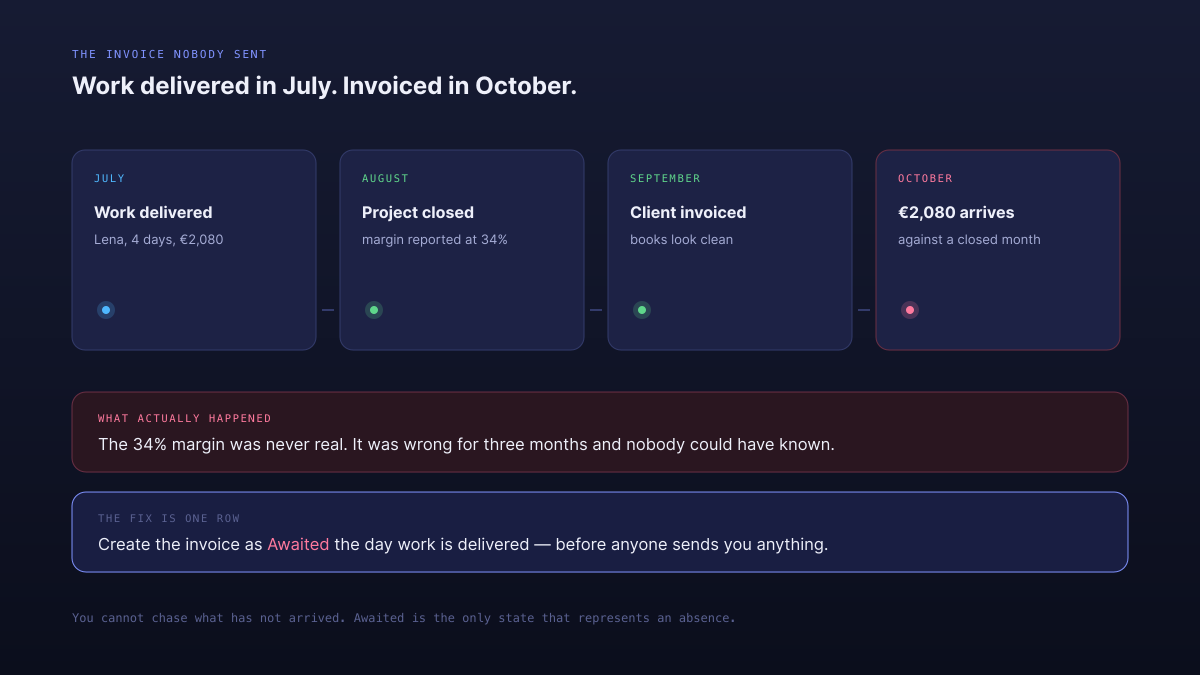
Create the invoice row when the work is delivered, in an Awaited state, before anyone sends you anything.
An invoice nobody has issued is invisible in every accounting system on earth — you cannot chase what has not arrived. So it shows up in month four, against a project you closed, reported margin on, and possibly already invoiced the client for. The month it lands is not the month it belongs to, and your numbers were wrong the whole time.
Awaited is the most useful state in the whole workflow, because it is the only one that represents something's absence.
What does this look like in Atwork?
The Freelancer & Subcontractor Management template ships this as four sheets.
- Freelancers — the bench, with day rate, availability, and an Onboarding state, because available and ready to book are not the same thing.
- Bookings — a task sheet, so a booking has a date and an owner. Carries the agreed rate for that job and the Pencilled/Confirmed distinction.
- Invoices — Awaited to Received to Approved to Paid.
- Compliance Docs — contract, NDA, insurance, tax form, each On file, Expiring or Missing.
The dashboards answer the two questions worth asking on a Monday: who is genuinely available, and what have we not been invoiced for yet.
If the freelancer spend is what is quietly eating a retainer, how to tell if a retainer is actually profitable is the arithmetic, and the Agency Client Delivery template links each deliverable to the freelancer booked on it.
Run one filter today: compliance documents set to Missing or Expiring. Most agencies find at least one person they have been booking for a year without a signed contract, and finding it on a quiet Tuesday is considerably better than finding it during a dispute.
Filter your paperwork to Missing, then mark every booking as pencilled or confirmed. Both take an afternoon. Start free