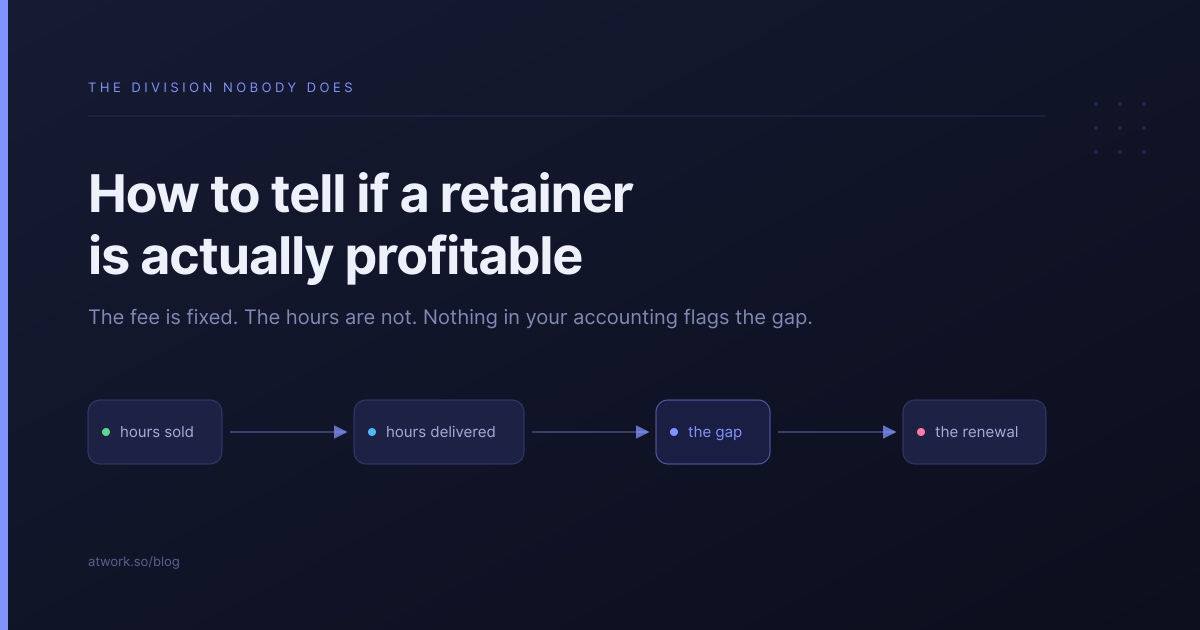
A retainer that invoices on time feels profitable. The money arrives every month, the client is happy, nobody is chasing anything. That feeling is the problem, because it is produced by the invoice rather than by the work, and the invoice is the one number that never changes.
Here is the arithmetic that decides it, and the four things you can do when it comes out badly.
Why does a retainer feel profitable and still lose money?
Because the fee is fixed and the hours are not. You sold 25 hours a month for a fixed price. In month one you delivered 24. By month six you are delivering 40 for the same fee, and nothing in your accounting flagged it, because the invoice was identical every time.
Retainers do not fail suddenly. They erode, an hour at a time, and each individual hour is a reasonable thing to have said yes to.
What is the actual calculation?
Monthly fee divided by the hours you actually delivered, compared against what an hour costs you to deliver.
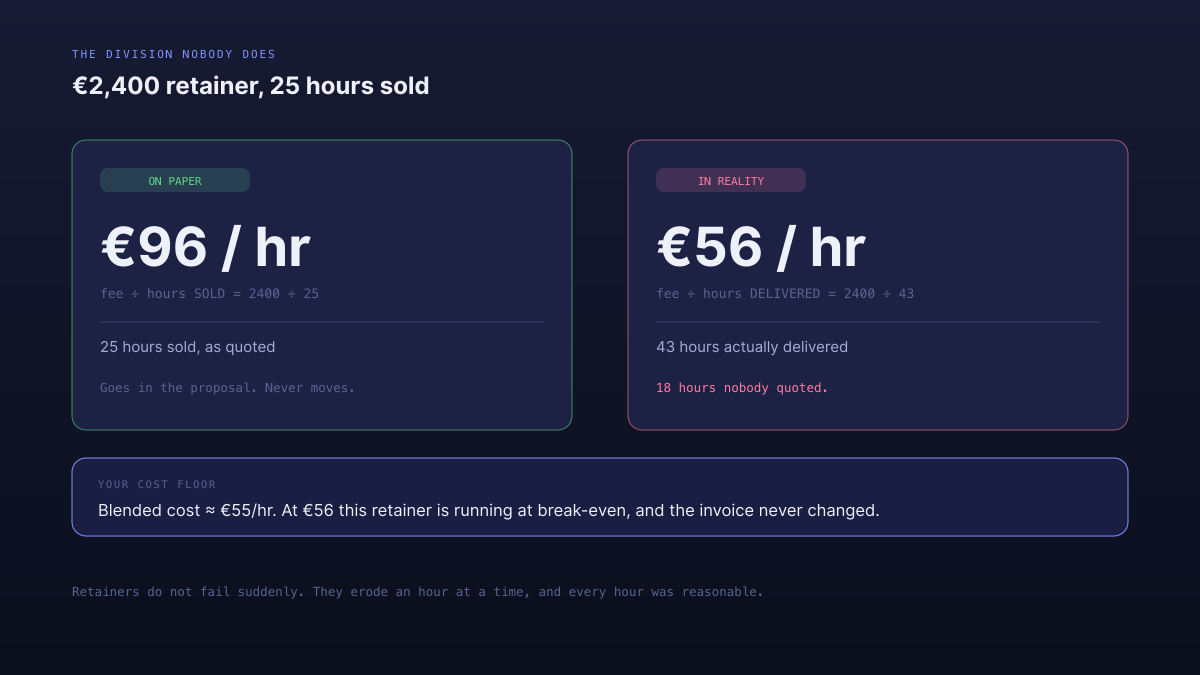
- Your paper rate is fee ÷ hours sold. A €2,400 retainer for 25 hours is €96/hour. That number goes in the proposal and never moves.
- Your real rate is fee ÷ hours delivered. The same retainer at 43 delivered hours is €56/hour.
- Your floor is what that hour costs you — salary, or contractor rate, plus whatever overhead multiplier you use. If your blended cost is €55/hour, that retainer is now running at roughly break-even.
The gap between €96 and €56 is not a rounding error, and it is invisible in every system that only records the invoice.
What counts as an hour you should be logging?
All of it, including the hours you feel slightly embarrassed to write down. Three categories, and the third is the one that matters:
- Billable — the work the retainer was sold to cover.
- Non-billable — internal time on that client: the retainer review, the handover note, the invoice query. Real, and rarely counted.
- Over-servicing — work you did for that client that nobody quoted. The extra variant, the quick report redesign, the ad-hoc data pull.
If your over-servicing column is always empty, the log is not being honest and the whole exercise is decorative. Nobody delivers a retainer for six months without a single unquoted hour.
Where does the gap usually come from?
Almost never one big thing. It is thirty small yeses that each took under an hour and none of which felt worth a quote.
The specific pattern to watch for is the recurring small ask. A four-hour report redesign is fine once. If the client now expects the nicer format every month, you did not absorb four hours — you re-priced the retainer downward by four hours a month and did not tell anyone, including yourself.
That is why a scope log is worth more than a time log alone. Time tells you the hours went somewhere; the scope log tells you what you agreed to and whether anyone decided it.
What do you do when a retainer is underwater?
Four options. All are legitimate, and picking none of them is the only real mistake.
- Reset the scope. Go back to what was sold and say plainly what is now outside it. Usually the cheapest fix, and clients accept it more often than agencies expect.
- Raise the price to match what you are actually delivering. Honest, and the one that risks the relationship most, so bring the numbers.
- Reduce the hours to match the fee. Rarely popular but occasionally correct, particularly when the client's own priorities have drifted.
- End it. A retainer running below cost with a client who will not renegotiate is a subsidy. Ending one usually frees capacity that is immediately more profitable elsewhere.
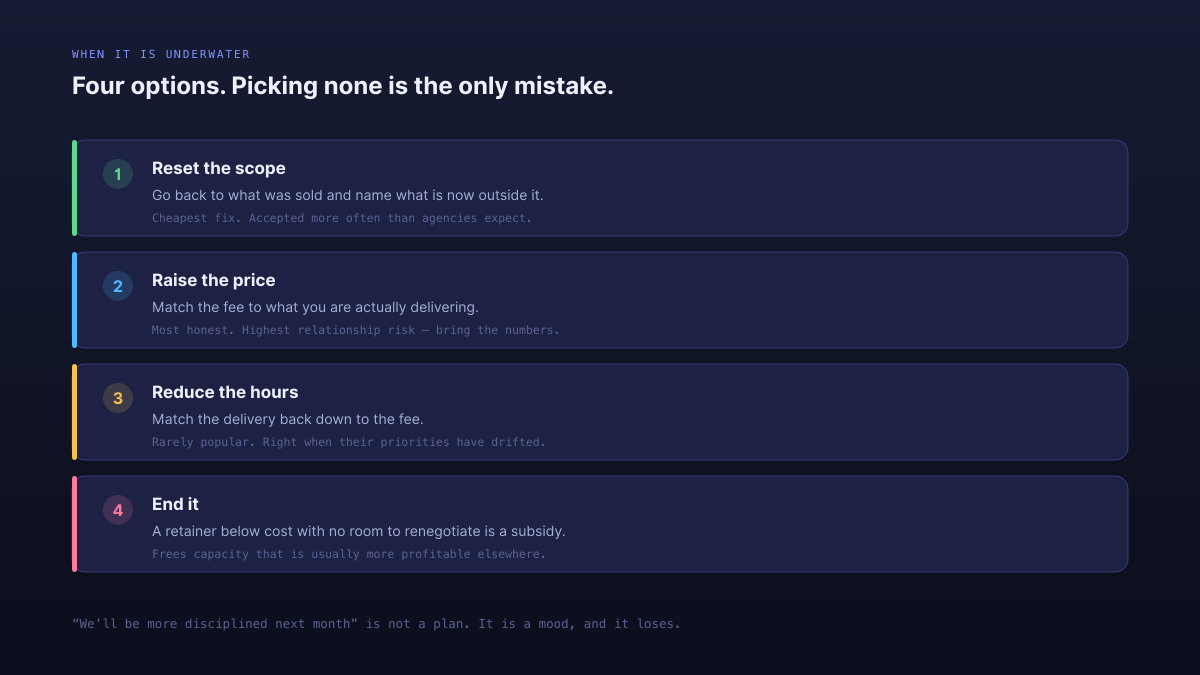
The one thing that does not work is deciding to be more disciplined next month. That is not a plan, it is a mood, and it loses to the next reasonable-sounding request.
How often should you check?
Monthly, and always before a renewal — never only at renewal.
Checking monthly is what makes the conversation small. We ran nine hours over in August, let's look at scope is a five-minute chat. The same conversation deferred to month twelve is we've been losing money on you all year, which is a negotiation you enter from a weak position and having sat on information the client would rather have had earlier.
The renewal date is the deadline, not the trigger.
What does this look like in Atwork?
The Retainer Management & Utilisation template ships this as four sheets and two dashboards.
- Retainers holds the monthly fee and the hours sold — the paper rate, written down where everyone can see it.
- Time Entries is what was actually delivered, each one Billable, Non-billable or Over-servicing.
- Scope Changes logs every extra request with its hours impact and what you decided: Absorbed, Quoted or Declined. It is a task sheet, so a pending decision lands in My Tasks rather than dying in a thread.
- People carries capacity and cost rate, so utilisation compares against something real.
One honest limitation: the effective rate is not computed for you. There is no formula support in the template format, so a calculated field would be a stale number pretending to be live. The dashboards give you fee, hours sold and hours delivered side by side, and the division is yours to do — which takes about ten seconds and is a more memorable ten seconds than reading a number somebody else calculated.
If the rounds rather than the hours are what is eating the retainer, why revision rounds multiply is the companion piece, and what to put in a monthly client report covers how to surface any of this to the client without it reading as a complaint.
Pick your largest retainer and log one honest month, over-servicing included. Then divide the fee by the hours you actually delivered. If that number is close to your cost rate, you have found the conversation to have before the renewal rather than during it.
Log one month honestly, then do the division. It takes an afternoon and it changes what you say at renewal. Start free