Most agency monthly reports are activity logs. Twelve slides proving the team was busy, a screenshot of a dashboard nobody asked for, and a summary that could describe any month of the engagement. Clients read the first page, skim for a number they recognise, and file it.
Nobody renews a retainer because you were busy. They renew because they can see what changed and they believe you know what to do next.
Why do clients stop reading agency reports?
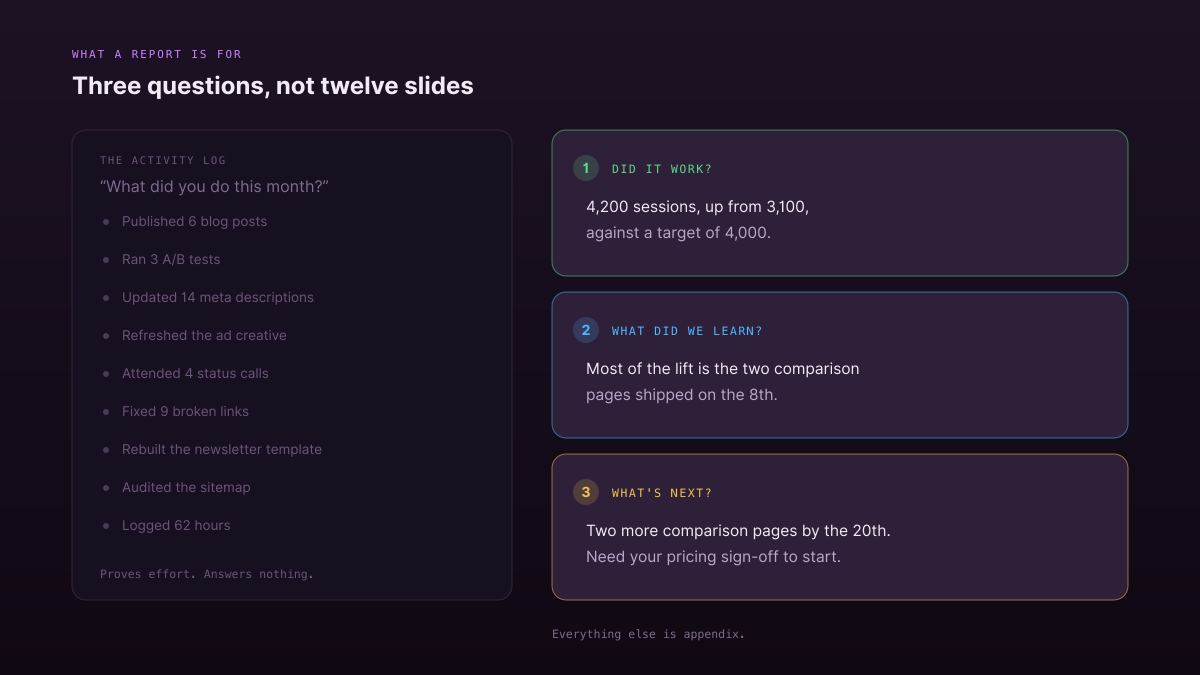
Because the report answers a question they were not asking. What did you do this month is an accountability question, and it is the one agencies instinctively answer, because it feels like proof of value. The client's actual question is whether this is working, and what happens now.
Once a report reads as self-defence, the client stops opening it and starts asking for a call instead — which is the outcome the report was meant to prevent.
What question is the report actually answering?
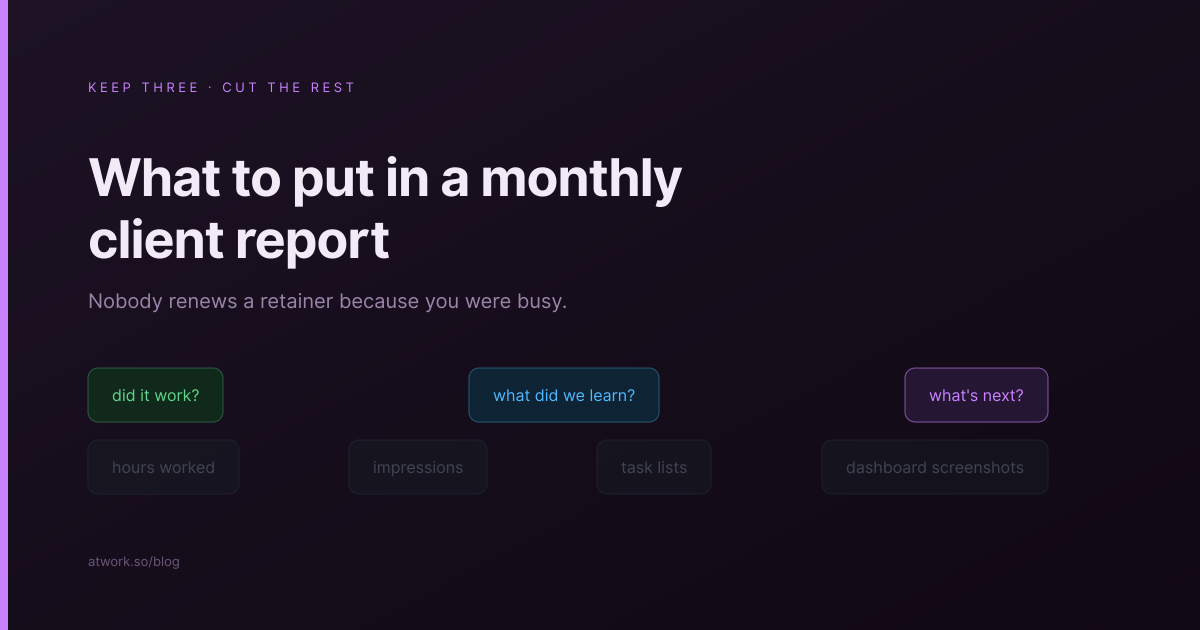
Three, in this order. Everything else is appendix.
- Did it work? Against the number you agreed at the start, not a number that happened to look good this month.
- What did we learn? The interpretation. This is the part a client cannot produce themselves, and the part that makes you hard to replace.
- What's next? One or two specific things, with dates. A report that ends without a decision is a newsletter.
What belongs in a monthly client report?
Five things. If a section does not serve one of the three questions above, cut it.
- The headline number, in context. Not 4,200 sessions but 4,200 sessions, up from 3,100, against a target of 4,000.
- What moved, and why you think it moved. Causation is a claim, so make it and label it as a claim. Traffic is up 35%; most of it is the two comparison pages we shipped on the 8th.
- What did not work. One item, honestly. More on this below.
- The decision you need from them. Even if it is small. A report with an ask attached gets read.
- What you are doing next month, in one or two lines they could repeat to their boss.
The last point is the real test. If your client cannot summarise your month in a sentence to somebody more senior, you have not written a report — you have written a record.
What should you cut?
Anything that measures your effort rather than their outcome.
- Hours worked as a headline. It invites the wrong conversation. Keep hours in an appendix if the contract requires them, and never lead with them.
- Vanity metrics with no target. Impressions and follower counts, unless you agreed at the outset that they matter.
- Screenshots of dashboards. If the chart is worth showing, rebuild it as one clear figure. A photograph of a tool is not a finding.
- The task list. Your client hired you so they would not have to look at it.
- Anything you cannot explain in one sentence. Complexity in a report is usually unfinished thinking.
How do you report a month that went badly?
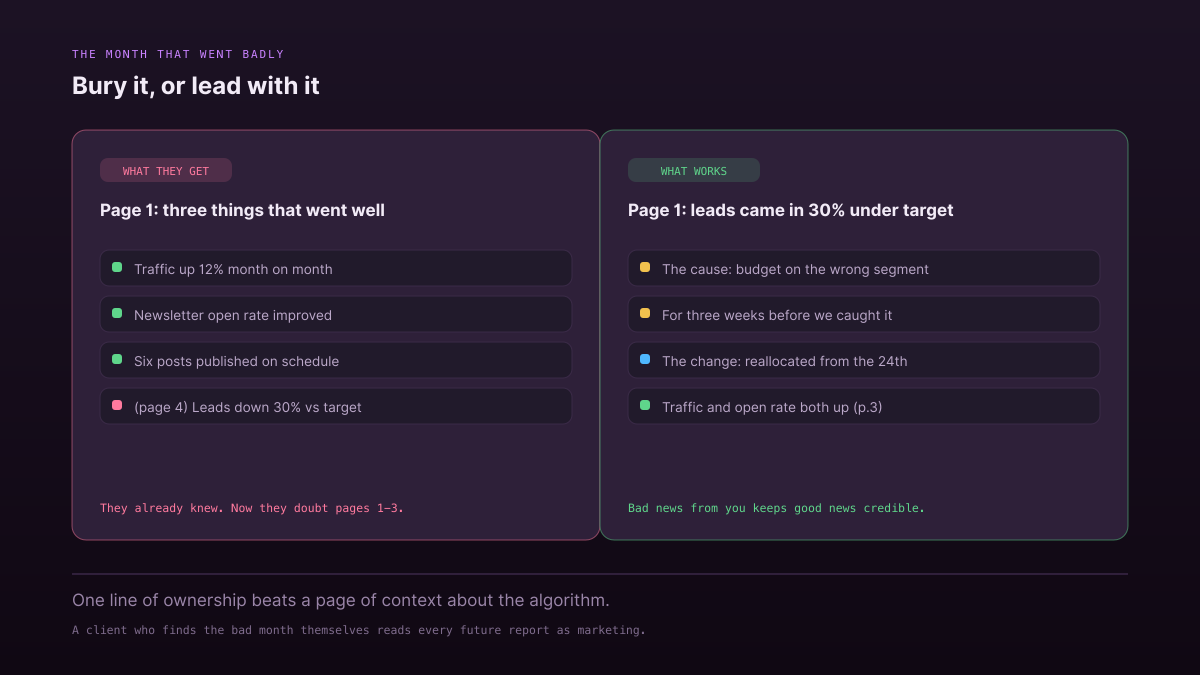
Lead with it, name the cause, and bring the change. In that order, on the first page.
The instinct is to bury a bad month behind the things that did work, and clients see through it every time — usually because they already know. Getting there first is the whole trick: a client who hears bad news from you keeps trusting the good news. A client who finds it themselves stops trusting the reports entirely, and after that every future report is read as marketing.
The month you report honestly is the month that buys credibility for the twelve after it.
What a bad month should not contain is a list of reasons that are all external. One line of ownership — we pointed the budget at the wrong segment for three weeks — does more for renewal than a page of context about the algorithm.
How long should it be, and who actually reads it?
One page for the approver, with the detail appended for whoever wants it.
Assume two readers. The person you work with daily will read everything and mostly already knows it. The person who signs the invoice will read the first page, in a hurry, possibly on a phone, and their impression decides the renewal. Write the first page for them and stop worrying about length after that.
This is also why the report should live somewhere they can open rather than only arriving as a PDF. The senior reader wants it at the moment they are thinking about you, which is rarely the day you sent it.
What does this look like in Atwork?
The report is a page that reads from the data you already keep, rather than a document you rebuild each month.
- Charts read from your sheets. If your work is tracked as rows, the numbers in the report are the same numbers you manage by, so there is no month-end reconciliation and nothing to retype.
- The written part is a page. The interpretation, the ownership and the next steps are yours to write — that is the part clients pay for and the part that should never be automated.
- The client reads it on their portal, so a senior stakeholder can open it in week three when they are actually thinking about the budget. The wider setup is in what your client should actually see in a portal.
- A scheduled workflow can draft it on the same day each month, which is how the cadence survives a busy week — what actually runs without you covers which parts are hands-off and which still need a person to read and send.
If you want this already built, the Client Reporting Hub template ships exactly this shape — one report per client per period as a task with a due date, metrics that each carry their target, and highlights split into what moved, what didn't, what we learned and what's next. The Agency Client Delivery template holds the sheets the numbers come from.
And if the question underneath the report is whether the account is profitable at all, how to tell if a retainer is actually profitable is the arithmetic. If the weekly update is what is eating your time rather than the monthly report, status updates without the weekly call is the companion piece.
Take your last client report and delete every section that measures effort rather than outcome. Whatever survives is the report. It is usually about a third of the length and considerably harder to write.
Rewrite one report around the three questions and send it a day early. Watch whether the follow-up call gets shorter. Start free