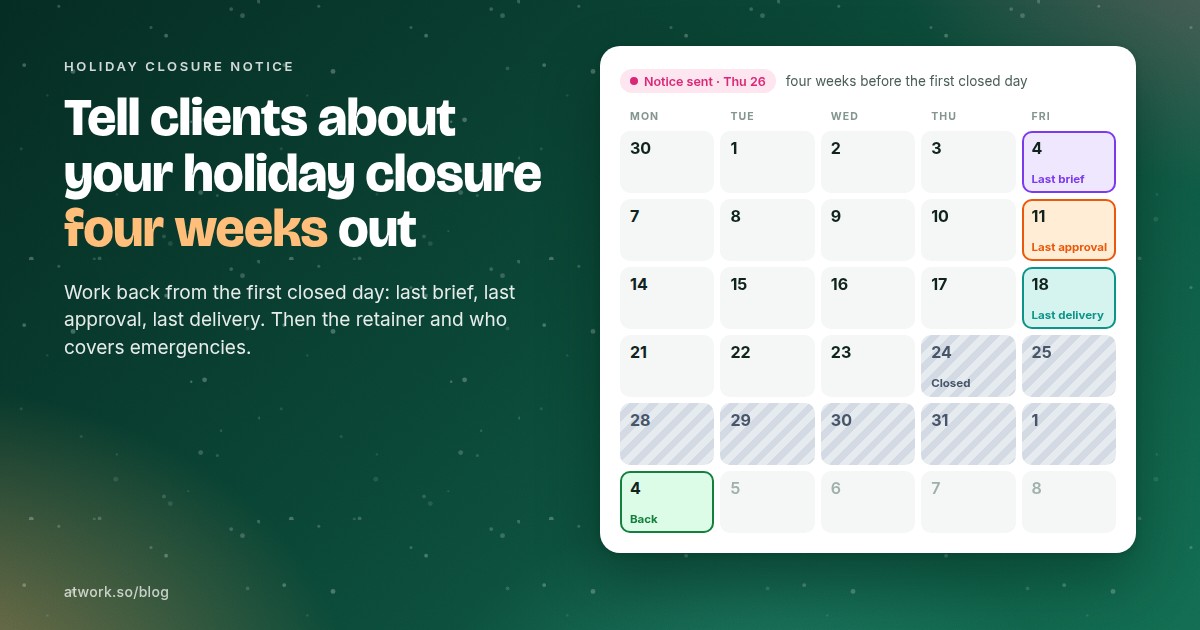
Most advice on telling clients about a holiday closure stops at the email template: closed from this date, back on that one, happy holidays. That says when you're away, not what the client must do before you go, which is where the December scramble starts. A useful notice works back from your first closed day: last brief, last approval, last delivery, the retainer and emergency cover. Send it four weeks out, written for each client: in Atwork, AI drafts each one from the client's row.
When should an agency tell clients about its holiday closure?
Tell clients four weeks before your first closed day. Your last approval date sits about two weeks before the closure, and a client needs about two weeks' warning to line up their own reviewers for it. For a closure that starts on Thursday 24 December, the notice goes out by Thursday 26 November.
December is the wrong month to start the conversation. In a Pathlabs survey of 266 independent agency executives, published in September 2025, two-thirds of agency leaders said they see a spike in campaign requests during Q4, and more than half get more reporting requests than usual. A mid-December notice lands in that spike, after the client's plan is set and their approvers have booked leave.
Which dates does the notice need: last approval, last delivery, back in office?
A holiday closure notice needs five dates, in the order the client acts on them: the last day for a new brief, the last day to approve work, your last delivery, the closure itself and the day you're back. Work them out backwards from the first closed day, and leave a revision round between each.

- The closure, both ends. Thursday 24 December to Friday 1 January, not "over the holidays".
- Back in office. Monday 4 January. A date, not "early January".
- Last delivery. Friday 18 December. Anything later moves to January, agreed now.
- Last approval. Friday 11 December. Feedback after it can't get a revision round before you close.
- Last new brief. Friday 4 December. Later briefs start in January, unless they're urgent and priced as rush work.
Then check each client's calendar, because their days off are not yours. The UK government's bank holidays page states the rule: "If a bank holiday is on a weekend, a ‘substitute’ weekday becomes a bank holiday, normally the following Monday." Boxing Day 2026 is a Saturday, so a London client is off on Monday 28 December.
| Client's market | Days off, end of 2026 | What it changes |
|---|---|---|
| England and Wales | Fri 25 Dec, Mon 28 Dec, Fri 1 Jan | Off on a Monday you may be working |
| Scotland | The same three, plus Mon 4 Jan | Off on your first day back |
| United States (federal) | Thu 26 Nov, Fri 25 Dec, Fri 1 Jan | A notice sent on Thanksgiving is read on Monday |
| Japan (government offices) | Tue 29 Dec to Sun 3 Jan | No public body signs anything for six days |
Sources: GOV.UK, the US Office of Personnel Management's 2026 schedule and Japan's Act on Holidays of Administrative Organs. Elsewhere, ask the client.
What happens to retainers while you're closed?
Decide what happens to each retainer and put that decision in the notice, in hours and in money. Three options cover most cases: unused hours roll over into January, December is prorated to the days you're open, or the retainer drops to monitoring only. What doesn't work is saying nothing and sending a full December invoice.
Take a retainer of 30 hours for €3,000 a month. December 2026 has 23 weekdays; closing from the 24th to the 31st takes out six, which leaves 17.
| Option | December for a 30-hour, €3,000 retainer | Fits |
|---|---|---|
| Hours roll over | €3,000 invoiced; about 22 hours delivered, 8 added to January | Content and design retainers |
| Prorated | €2,217 invoiced, for 17 of 23 days; about 22 hours | Retainers sold as monthly capacity |
| Monitoring only | The agreed fee; uptime and security alerts watched, no new work | Site care and hosting |
Log December against the retainer as usual: the gap between hours sold and hours delivered is the number that matters at renewal (how to stop over-servicing retainer clients), and the Retainer Management & Utilisation template keeps the two apart. If a retainer renews in January, retainer renewal reminders bring that conversation forward to before the break.
Who covers emergencies, and what counts as one?
Emergency cover during a holiday closure means one named person for each closed working day, reachable at one address, with a response time they can keep. Then define an emergency in the notice as something that stops the client trading or exposes them: the site is down, checkout fails, a security alert. A copy change is not an emergency.
- What counts: the site or shop is down, payments or forms fail, a security incident, a takedown request.
- What waits: new ideas, copy and image swaps, reports.
- One way in: a shared address or phone number, not five personal inboxes.
- A response time: for example within four hours, 10:00 to 16:00.
- Who pays: inside the retainer, or billed on top.
The list protects your team too. In a Pew Research Center survey of 5,188 US workers in February 2023, 46% of those with paid time off said they take less time off than they're allowed. Of that group, 49% said they worry about falling behind at work. One named cover person lets everyone else switch off.
How do you keep the December plan on track?
Give every December deliverable a due date before your last delivery day, and move the rest to January now, with the client, not on the 18th. The list of what's due after the cutoff is the agenda for each notice: every item on it moves earlier, moves to January or needs a decision from the client.
Seventeen working days is December's real capacity, and utilisation measured against a full month makes a short month look like a bad one. Put the December report's date in the notice too. And requests after the last-brief date are rush work: quote them as rush or move them to January.
How do you send a notice per client from the client record?
Keep the dates, the retainer decision and the emergency cover as fields on each client's row in Atwork. AI drafts each notice from those fields, you approve it, and a workflow sends it on the notice date. One email to everyone is faster; a notice per client stops the "but our launch is on the 22nd" reply.

- On the clients sheet of your client database, add Last brief, Last approval, Last delivery and Notice date as Date fields. Then add Retainer over the closure as a Select, Emergency cover as an Employee field, Their days off as Short text, Holiday notice as Long text and Notice approved as a Checkbox.
- Click the Holiday notice column header, choose Autofill, then AI. Write the instruction, for example: We're closed from Thursday 24 December to Friday 1 January and back on Monday 4 January. Write this client's holiday-closure notice from these dates, the retainer decision and the emergency cover. Mention their own days off. Under Reads, pick the fields from step 1 and the client's name.
- Use Fill existing rows… to draft every client at once. It shows the rows and the estimated cost first (fill a field automatically).
- Read each draft, fix it and tick a Notice approved checkbox. A value you edit is yours: later fills never change it.
- Create a workflow with the Date reached trigger on Notice date, the condition that Notice approved is ticked, and a Send Email step with the client's email address and the Holiday notice inserted from the row.
Send Email needs a connected SMTP account, and Date reached workflows come with the Business plan (pricing). The condition is checked when the date arrives, so a notice nobody approved stays unsent (how date triggers work). Or ask Dana on the sheet to add the fields and draft the workflow, and check it before you apply it.
| One email to all clients | Atwork | |
|---|---|---|
| Time to send | Faster: one message, written once | A morning to set up and read the drafts |
| Dates | One set for everyone | Each client's own, from their row |
| The client's days off | Left out | In the draft |
| Retainer terms | Generic, or missing | The decision on the row |
| Next year | Rewrite last year's email | Change the dates and fill again |
Frequently asked questions
How far in advance should you tell clients about a holiday closure?
Four weeks before the first closed day. That gives the client two weeks to plan around your last approval date, which sits about two weeks before you close.
What should a holiday closure notice include?
The first and last closed days, the day you're back, the last day for a new brief, the last approval and delivery dates, what happens to the retainer, and who to contact in an emergency.
Is an out-of-office reply enough?
No. An auto-reply reaches a client only after they write to you, usually about something already late. Use it to repeat the back-in-office date and the emergency address.
Where do you start this week?
Pick your closure dates today and work back from the first closed day: last delivery, last approval, last brief. Write down the retainer decision and the emergency cover for each client, then send each notice four weeks before you close.
Put your clients in one sheet, give each one their closure dates, and let AI draft the notices for you to approve. Start free