
A rush fee is what you charge when a client asks for work with less notice than your published threshold. In December, the easy move is to absorb the rush to be nice, and the team and the other clients pay for it in late nights and slipped dates. In Atwork, each client's threshold sits on their client row, and every request is a row with its dates.
What counts as rush work?
Rush work is any request a client wants delivered in fewer working days than your standard turnaround for that kind of work. The threshold has to be a number, written down and the same for every client: "less than five working days' notice", not "when it feels tight". Without a number, every request is a negotiation.

Two rules keep the number honest:
- Count working days, not calendar days. A brief that lands on Friday afternoon for Monday has one working day of notice, not three.
- Start the clock when the complete brief arrives. The first "can you do something for the sale?" email is not a brief. The one with copy, sizes and a decision-maker is.
A rush request is often scope creep with a deadline attached. Scope creep: the change request nobody sends covers the scope half. This post is about the clock.
Why is absorbing rush work expensive?
Absorbing rush work is expensive because someone pays for every rush, and if it isn't the client, it's your team and your other clients. A rush pushes planned work back, pulls people into evenings and raises the error rate on the work the client cares about most. A rush fee bills that cost to the client who caused it.
December makes it worse. In a survey of 266 independent agency executives published by Pathlabs in September 2025, two-thirds said they see a spike in campaign requests during Q4. In the same survey, 58% said their clients had more aggressive expectations in Q4 than in previous quarters.
The extra hours buy less than they seem to. John Pencavel's study of British munition workers' output and hours during the First World War found output rose in step with hours below 49 hours a week and more slowly above that. Output at 70 hours a week differed little from output at 56. Factories aren't studios, but the shape will be familiar to anyone who has run a December.
Mistakes rise too. When 393 hospital staff nurses logged 5,317 shifts for a study in Health Affairs, their risk of making an error was significantly higher when shifts ran past twelve hours. It was also higher when they worked overtime or more than forty hours a week.
The rest of the team pays even when nobody stays late. In a study by researchers at UC Irvine and Humboldt University, people finished interrupted tasks faster, but reported more stress, frustration, time pressure and effort.
"So interrupted work may be done faster, but at a price." Gloria Mark, Daniela Gudith and Ulrich Klocke, The Cost of Interrupted Work: More Speed and Stress
The quietest cost: a client whose rush was free once learns that your notice period is optional.
How much do agencies charge for rush work?
There is no industry standard for rush fees, so be wary of anyone quoting a "typical" percentage. What works is a published ladder: the shorter the notice, the higher the uplift, in steps the client can read before they order. The US federal judiciary publishes exactly that for court transcripts, and it makes a good model.
| Turnaround | Price per page | Uplift on 30 days |
|---|---|---|
| 30 days (ordinary) | $4.40 | none |
| 14 days | $5.10 | +16% |
| 7 days (expedited) | $5.85 | +33% |
| 3 days | $6.55 | +49% |
| Next day | $7.30 | +66% |
| 2 hours | $8.70 | +98% |
These are the maximum per-page rates for an original transcript, effective 1 October 2024 and still listed in November 2026. Copy three things: each step is tied to notice, not effort; the top step nearly doubles the price; and the schedule is public, so nobody argues at the moment of ordering.
A small studio's ladder might read: under five working days' notice, +25%. Under two, +50%. Next day, +100%, and only if someone is free. Those are examples, not a benchmark. Set yours from your own lead times, and price the base work first: three ways to price an agency retainer covers that.
Percentage or flat fee?
Use a percentage rush fee on project work with a quoted price, a flat fee on small and frequent retainer asks, and a priority tier for clients who rush every month. The model matters less than the threshold. Pick the one a client can predict before they send the request, and keep it all year.
| Percentage uplift | Flat fee | Priority tier | |
|---|---|---|---|
| How it works | The job's price plus a set percentage | A fixed amount per rushed request | A monthly add-on that buys faster turnaround |
| Example | A €900 job at +50% costs €1,350 | €300 per rush, whatever the size | €500 a month for up to two 48-hour turnarounds |
| Fits | Project work with a quoted price | Small asks on a retainer | Clients who rush every month |
| Weak spot | Too small on small jobs to change anything | Too cheap on big jobs | Bought once, then treated as the normal speed |
Give a percentage a floor, so a rushed €200 resize still costs something. And note what a priority tier really is: reserved capacity, paid monthly. That makes it a retainer decision, and project or retainer is a question about risk: with a tier, you carry the risk that the client rushes more than they paid for.
How do you tell clients before December, not during?
Tell clients about a rush fee in one short note in November: the threshold, the fee, the date it starts and your last brief dates before the holidays. Announce it in advance and it is a policy. Announce it on 15 December in reply to a request and it reads as a penalty, and the client argues with it.
The note needs five things:
- The threshold. "Requests with less than five working days' notice are rush work."
- The fee. The ladder or the flat amount, in the client's currency.
- The start date. 1 December gives everyone two weeks to adjust.
- The last brief dates. The last day to brief work you can still deliver before you close for the holidays.
- The way out. What takes a request out of rush: an earlier brief, a later date or a smaller scope.
Send it with the December plan. A client who has just agreed what December holds can see why a surprise on top of it costs more.
How does Atwork keep the rush rule in front of the team?
Atwork keeps the rush rule where requests land. Each client's rush terms sit on their row in the sheet where you keep your clients, and every request is a row with the date it came in and the date it's wanted. Set a Rush field on arrival, and the fee is part of the quote, not a later argument.
- On the client's row: their notice threshold, their fee model and the date you sent the note.
- On each request: Received, Wanted by, working days' notice and Rush. A view filtered to Rush lists every one of them.
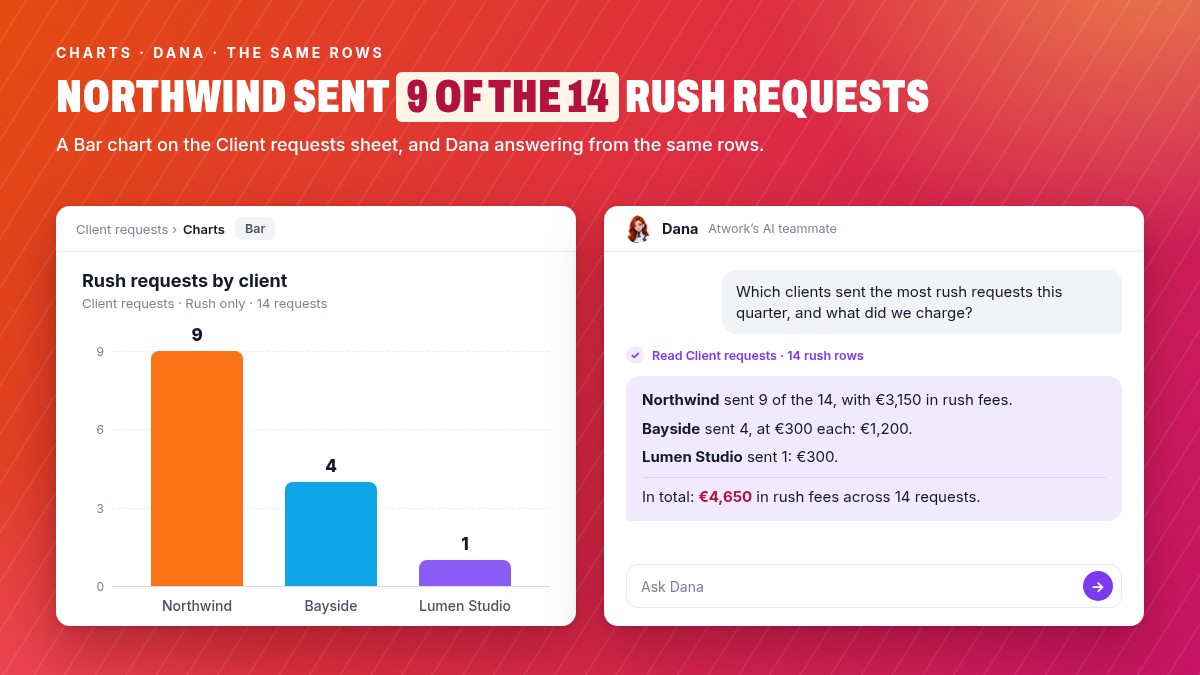
- When you review: ask Dana "Which clients sent the most rush requests since September, and what did we charge?" She reads the requests sheet and answers with counts and totals per client. A Chart keeps the same numbers on screen.
That count is what you bring to January, when the client who rushed nine times is due a talk about a priority tier. How agencies run client work in Atwork shows the rest of the setup.
Frequently asked questions
Is a rush fee the same as charging for overtime?
No. Overtime is your cost. A rush fee is the price of the client's short notice. Charge it even when nobody stays late, because the rush still moved someone else's work.
Should retainer clients pay rush fees?
Yes, unless the retainer already buys faster turnaround. Write the threshold into the retainer terms. A priority tier is the cleanest way to sell speed to a client who needs it every month.
What if the client sends feedback late but keeps the deadline?
Count notice from the day the complete feedback arrives. If that leaves less time than your threshold, the rest is rush work, and the note you sent in November already says so.
What should you do before December starts?
Pick a rush threshold in working days, pick one fee model and send the note to every client before 1 December. Then log every rush request with its dates, so January's pricing review starts from counts instead of memories. Rush work you charge for is a service. Rush work you absorb is a discount nobody asked for.
The 26 November issue of Atwork Notes, our newsletter for small teams, is about agreeing December's plan with each client in November.
Put each client's rush terms on their row and log every request with the date it came in. By January you'll know who rushed, how often and what it was worth. Start free