
Retainer pricing advice usually arrives as a slogan: charge for value, not for time. It is good advice and it is not actionable, because it skips the question underneath. Before you can decide what a month is worth to the client, you need to know what a month costs you to deliver — and most agencies are working from the estimate they wrote during the pitch rather than from what actually happened.
What are the three ways to structure a retainer?
By the hour, by the scope, or by the outcome. Each sells something different, each fails differently, and the choice should follow from which failure you can live with rather than from which sounds most sophisticated at a conference.
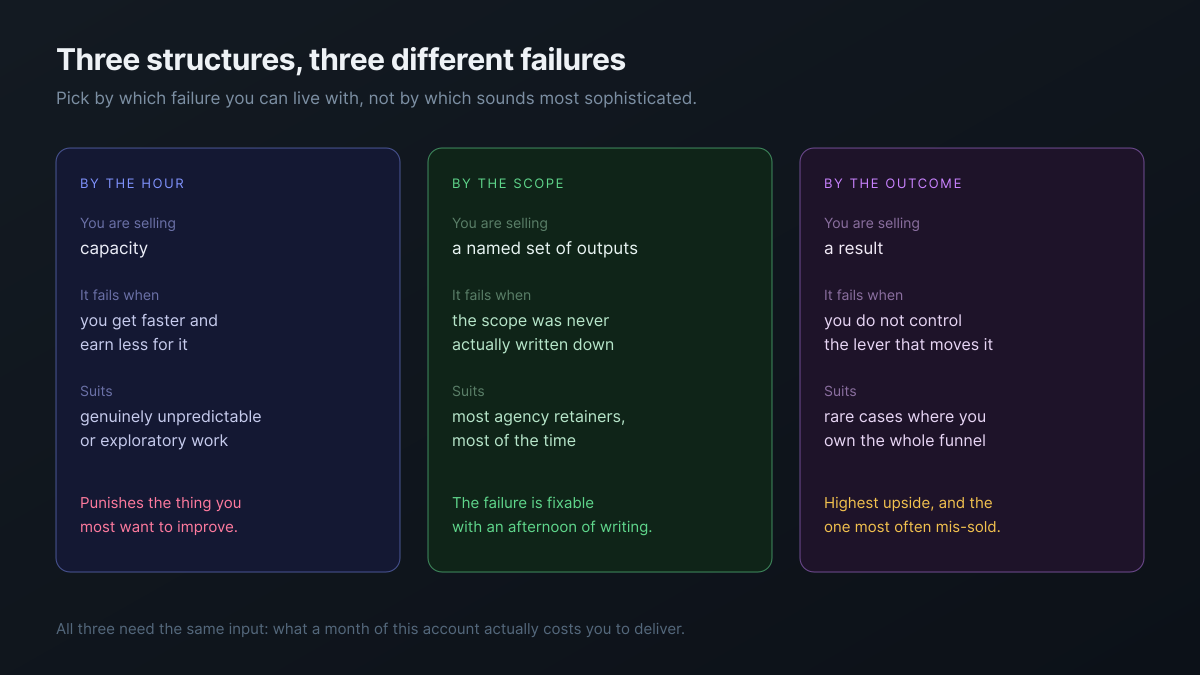
- By the hour. You sell capacity. It has the cleanest logic and one perverse consequence: getting faster earns you less, so the structure punishes the improvement you most want to make.
- By the scope. You sell a named set of outputs. It fails when the scope was never really written down, which is a fixable failure — an afternoon of writing rather than a change of business model.
- By the outcome. You sell a result. The upside is real and so is the risk, and it only works where you genuinely control the lever that moves the number.
For most agency retainers, scope-based wins, and it wins for an unglamorous reason: it is the only one of the three whose failure mode you can fix on your own without renegotiating anything.
Why does outcome pricing go wrong so often?
Because agencies sell it while owning perhaps a third of the funnel. If your work drives qualified leads and the client's sales team converts them, an outcome-priced retainer makes you financially responsible for a team you cannot manage, do not see, and did not hire.
That is not an argument against it. It is an argument for checking one thing first: can you name the lever, and do you control it end to end? Where the answer is genuinely yes, outcome pricing is the best-paid structure in the category. Where it is nearly yes, it is a way of taking on someone else's operational risk for free.
What has to be true before any of the three works?
You have to know what a month actually costs to deliver — measured, including the hours nobody billed. This is the input every structure needs, and it is the one most agencies substitute with a guess made before the account existed.
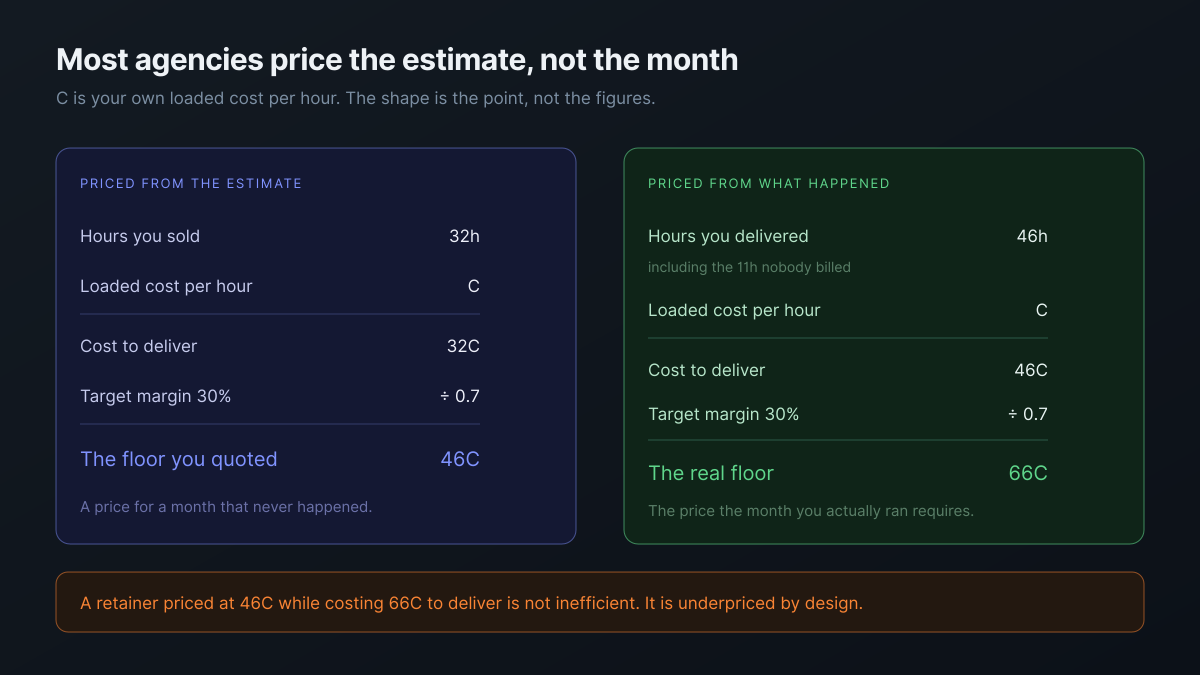
The arithmetic is deliberately expressed against C, your own loaded cost per hour, because the shape is transferable and the figures are not. Take the hours you genuinely delivered last month, multiply by your loaded cost, divide by one minus your target margin, and you have a floor. A retainer priced below that floor is not inefficient — it is underpriced by construction, and no amount of process improvement will rescue it.
If you have never measured a delivered month, you are not pricing the account. You are pricing the version of it you imagined during the pitch.
The gap between hours sold and hours delivered is usually the unbilled favours, and finding them is a separate exercise: how to stop over-servicing retainer clients covers how to surface them, and agency utilisation rate covers why your existing reports are unlikely to show them.
How do you set the number without guessing?
Work from the floor upwards, in this order. The sequence matters because each step depends on the one before it, and skipping to the last step is what produces a number nobody can defend.
- Measure one delivered month on a comparable account, favours included.
- Calculate the floor — delivered hours times loaded cost, divided by one minus target margin.
- Decide the structure from the three above, based on what you control.
- Write the scope and the exclusions, because that is what the number is attached to.
- Set the review date at the same time as the price. A retainer with no review date is a price that only ever moves down in real terms.
Step five is the one that gets skipped and the one that compounds. A retainer set two years ago at a number nobody has revisited is quietly cheaper every month, and the conversation gets harder the longer it waits.
What about the client who only wants a number?
Give them one, and keep the scope attached to it. The failure is not quoting a round monthly figure — clients want that and it is reasonable. The failure is quoting it without a written statement of what it buys, because then the number is fixed and the scope is not.
| Dimension | A number in an email | Atwork |
|---|---|---|
| What the price is attached to | Nothing durable | A written scope, on the account |
| Finding out what a month cost | Rebuild it from timesheets | Read it off the delivered work |
| Noticing drift | When margin already hurts | When the item is tagged out of scope |
| Review date | Remembered, or not | A dated item that surfaces itself |
| Stops a client negotiating hard | No | No — pricing is still a conversation |
When should you raise an existing retainer?
When the delivered month has moved away from the sold month and stayed there for a quarter. One heavy month is noise; a quarter of them is the new shape of the account, and pricing it as if it were still the old shape is a decision you are making by not making it.
Bring evidence rather than a feeling. Four months of delivered hours next to the scope you agreed is a conversation about facts, and it is notably easier than the version where you ask for more money because it feels tight. If the answer is no, that is information too — how to tell if a retainer is actually profitable covers what to do with it.
Where should you start this week?
Take your largest retainer and reconstruct one delivered month, favours included. Not the estimate, not the timesheet summary — what actually happened. Then run the floor calculation against your own loaded cost.
Most agencies doing this for the first time find one account priced comfortably above the floor and one priced below it, and had no idea which was which. That is the whole value of the exercise: it turns a vague sense that some clients are hard work into a number you can act on.
The Agency Client Delivery template ships the sheets the delivered hours come off, and the agencies overview covers the wider setup.
Reconstruct one delivered month on your biggest retainer, then run the floor calculation. Compare it to what you charge. Start free