
The standard advice is to move everything to retainers, because recurring revenue is more valuable than project revenue. The first half is true and the second half is the reason agencies end up with retainers that quietly lose money. Recurring revenue is the reward for taking on a particular risk, and the question worth asking first is whether you are set up to carry it.
What is actually different between a project and a retainer?
Who absorbs the uncertainty. There are two kinds — uncertainty about the work itself, and uncertainty about whether the client needs any work this month — and each pricing model assigns them differently, whether or not anyone discussed it.

A fixed-price project hands you scope risk and hands the client demand risk — they have to keep coming back. Time and materials hands both to the client, which is why it is the safest to deliver and the hardest to sell. A retainer is the only one of the three where you carry both.
A retainer is not a better business model. It is a trade: predictable revenue in exchange for both of the risks.
That trade is often worth making. It stops being worth making when it is made by default, because nobody priced for the second risk.
Which risk should decide the model?
Whichever one you can actually measure. Two questions settle it, and neither of them is about revenue preference.
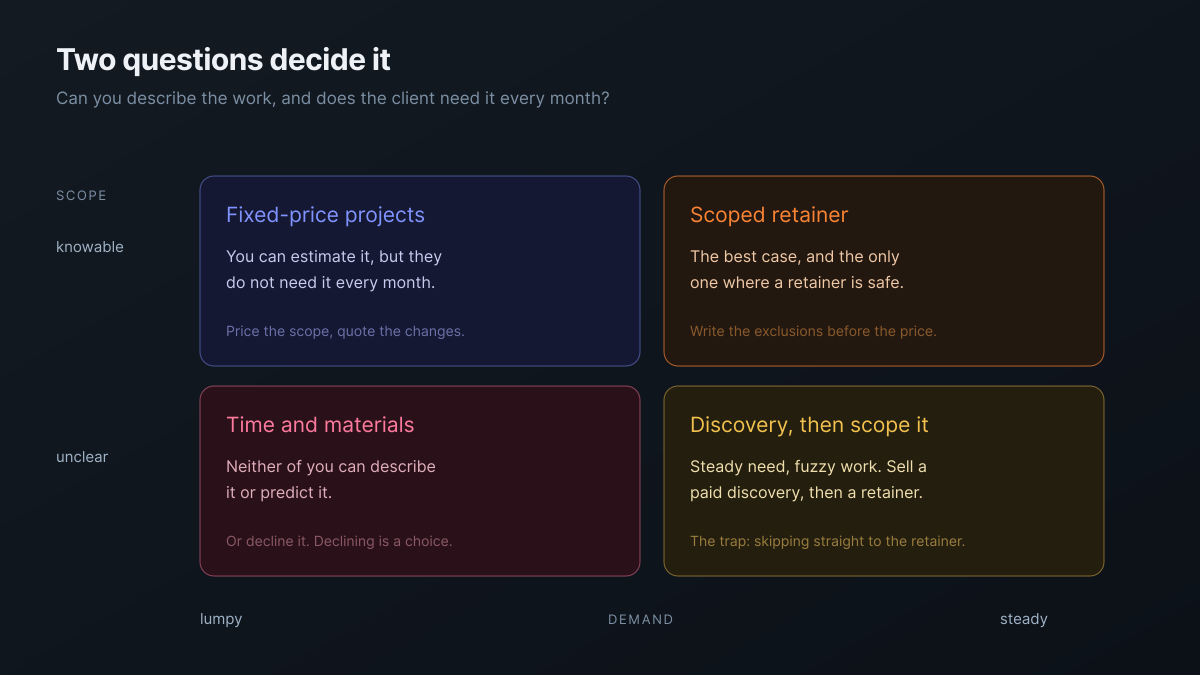
- Can you describe the work? If you can write down what is included and excluded, you can price scope. If you cannot, no pricing model saves you — it only decides who finds out first.
- Does the client need it every month? Steady demand is what makes a retainer honest. Lumpy demand dressed as a retainer means one of you is subsidising the other in alternating months, and eventually noticing.
The quadrant that catches most agencies is steady demand with unclear scope. The need is obviously real and recurring, the work is genuinely hard to pin down, and the temptation is to go straight to a retainer and sort the details out later. That is the one to resist — sell a paid discovery, scope it properly, then price the retainer against something written.
Are retainers really more valuable?
Yes, and the reason is worth stating precisely, because the vague version leads people astray. A retainer is more valuable because it removes the cost of re-selling and the gap between engagements, not because the revenue per hour is better. Per hour it is usually worse.
That distinction matters when you compare. A project at a healthy margin beats a retainer at break-even every time, and no amount of predictability fixes a fee that sits below what the month costs to deliver. The arithmetic for checking that is in how to tell if a retainer is actually profitable, and three ways to price an agency retainer covers setting the number in the first place.
What makes a retainer go wrong?
Carrying the demand risk without pricing for it. When demand is low the client feels they are paying for nothing and starts inventing work to justify the fee; when demand is high you absorb the overflow because saying no in month seven is harder than it was in month one.
Both failure modes come from the same root: the retainer says what it costs and not what it covers. Writing the exclusions is what converts a retainer from a standing invoice into an agreement, and it is genuinely an afternoon of work. How to stop over-servicing retainer clients covers what to write and how to catch the drift early.
| Dimension | Fixed-price project | Retainer |
|---|---|---|
| You carry scope risk | Yes | Yes |
| You carry demand risk | No | Yes |
| Revenue predictability | Low | High — the real prize |
| Cost of re-selling | Every engagement | Once |
| Margin per hour | Usually better | Usually worse |
| Fails because of | A brief nobody settled | A scope nobody wrote |
When should you move a client from projects to a retainer?
When you have run enough projects with them to know what a typical month contains. That is the honest trigger, and it is an evidence threshold rather than a sales milestone.
Three projects is usually enough to see the pattern: what they ask for, how much of it arrives unplanned, how long their approvals take. Without that, a retainer is a guess with a monthly invoice attached, and the guess is almost always optimistic because it was made while everyone was pleased with each other.
It is also reasonable to move the other way. A retainer that has become lumpy is a project client who has not been told yet, and converting back is a smaller conversation than most agencies expect — particularly when you bring the pattern of the last six months rather than an assertion.
Where should you start this week?
Take your three largest accounts and mark each one on the two questions: is the scope knowable, and is demand steady. Do it from what actually happened over the last quarter, not from what the engagement was sold as.
If any of them sit in the steady-demand, unclear-scope quadrant and are already on a retainer, that is the account to look at first. It is not necessarily unprofitable yet, but it is the one carrying risk nobody priced, and it will be the one that surprises you.
The Retainer Management template ships the sheets for tracking the fee against what gets delivered, and the agencies overview covers the wider setup.
Mark your three biggest accounts on scope certainty and demand steadiness, using last quarter's reality rather than the pitch. Start free