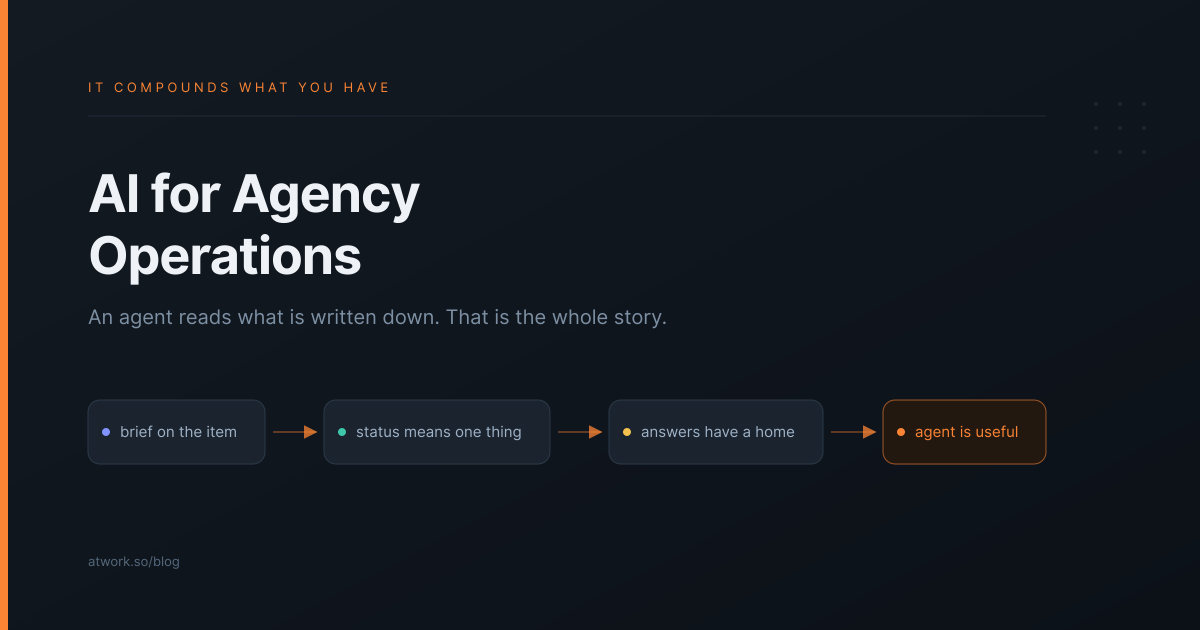
The pitch for AI in agency operations is that it will fix the mess. It will not. An agent reads what is written down and acts on it, which means it amplifies whatever your operations already are — good ones get faster, and vague ones produce confident, wrong output faster than a person ever could. That is worth knowing before you buy anything, because the preparation that makes an agent useful is ordinary operations work, and most of it is worth doing whether or not you ever add AI.
What does an AI agent actually need from your operations?
Three things, none of them technical: a brief it can read, a status that means something specific, and a place where the answer lives. Give it those and it can take real work off your desk. Withhold them and it will guess, plausibly, in your house style, and you will not notice until a client does.
An agent has no corridor. It cannot overhear the thing everyone knows, ask the person sitting opposite, or infer that review means something different for this client. It sees the item.
Why does AI make bad operations worse rather than better?
Because the failure is silent. A person handed a vague brief asks a question; that question is the system working. An agent handed a vague brief produces something, and the gap between the brief and the intent shows up later, in a deliverable, in front of someone who is paying you.
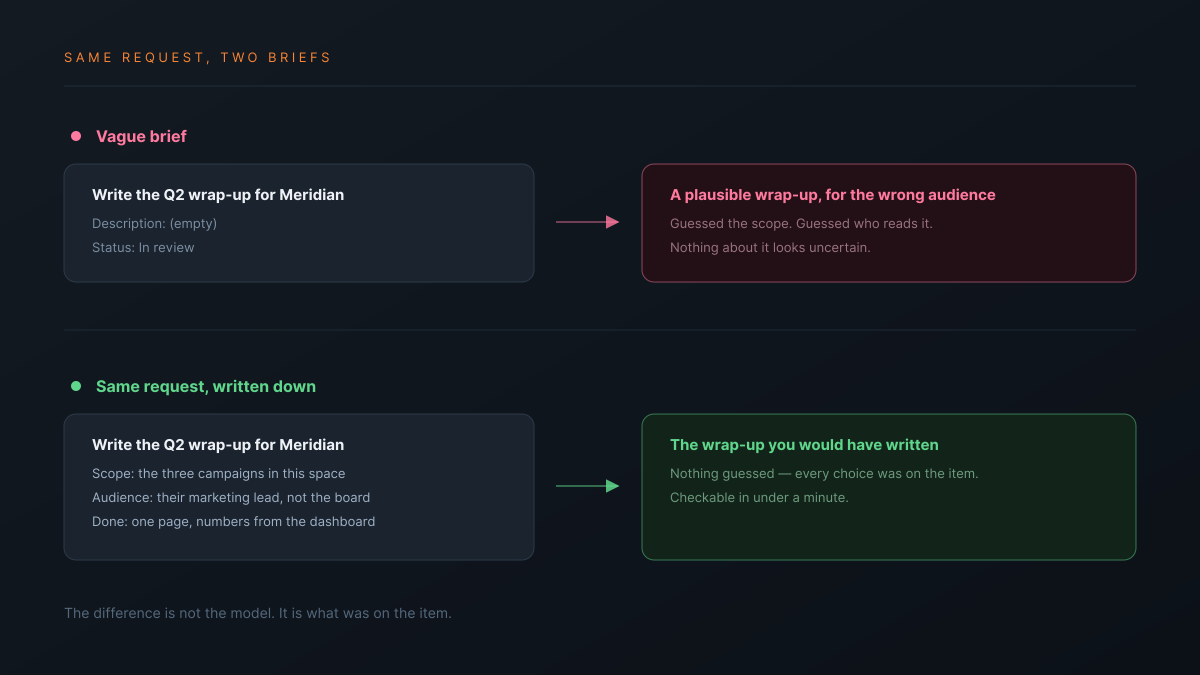
- A person escalates ambiguity. An agent resolves it. Usually in the most common direction, which is not always yours.
- Volume multiplies the error. One person misreading a brief is one deliverable. An agent doing it across nine clients is nine.
- Confidence is the tell you do not get. The output does not look uncertain, because nothing about being wrong makes text look wrong.
An agent does not have opinions about your process. It has opinions about the text in front of it, which is why the text in front of it matters more than the model behind it.
What is worth fixing first?
The things that are cheap to write down and currently live in people's heads. None of this is AI work — it is the operations work you have been postponing, and the agent is just what finally makes the cost of postponing it visible.
- Define what each status means. Not the label, the exit condition. In review means the client has it, or it means a colleague has it, and the board is worth nothing while it means both.
- Put the brief on the item. Not in the thread, not in a deck someone linked once. The first thing an agent reads is the description.
- Name the definition of done. One sentence per recurring deliverable. This is the single highest-return thing on the list.
- Decide where answers live. If the same question is answered three times a month in chat, that answer has no home, and neither a new hire nor an agent will find it.
Do those four and your ops improve whether or not anything AI-shaped ever touches them. That is the honest framing: this is not preparation for a tool, it is the work.
Which operations jobs pay off first?
The repetitive translations — turning one written thing into another written thing, where the inputs already exist and the output has a known shape. We listed the specific jobs in what you can actually hand over, and the mechanics of handing them over in how to delegate work to an AI agent.
The pattern worth internalising is narrower than "automate operations": an agent is good at the jobs where a competent person with no context could do it correctly given only what is on the item. If a job fails that test, the fix is not a better prompt. It is more on the item.
How do you tell whether it is working?
Read the trace before you read the output, for the first several runs. Every run records the steps taken, the tools used, what came back and whether anything needed approval — and the trace answers a question the output cannot: did it approach this the way we would have.
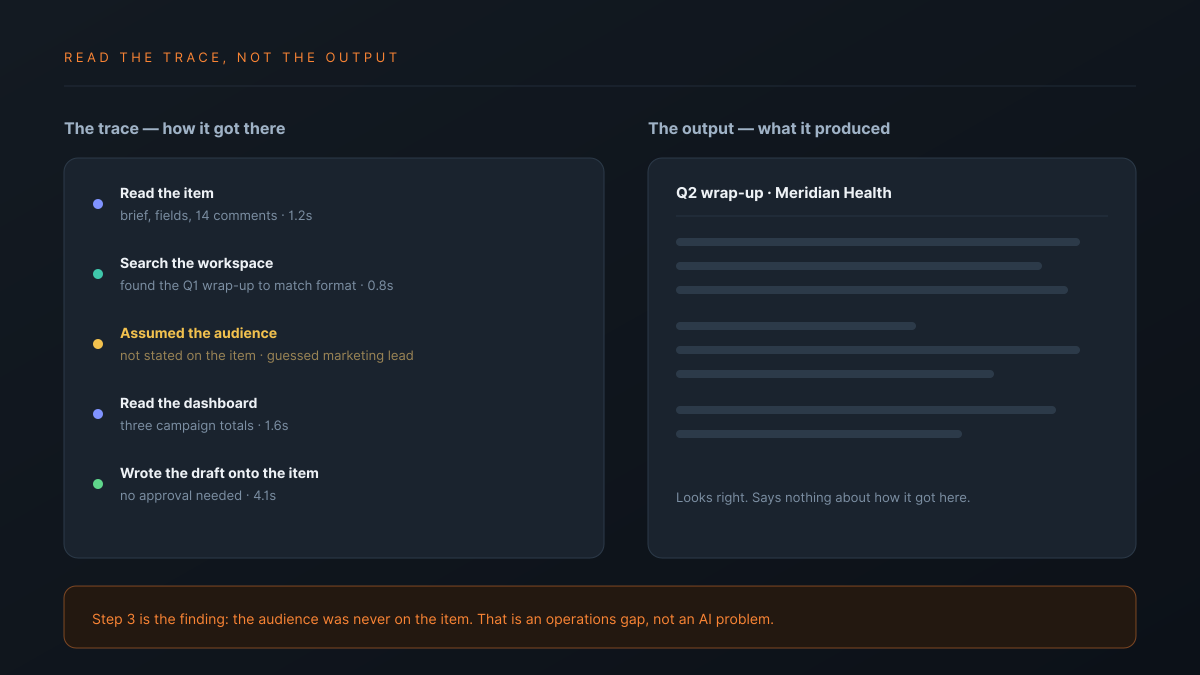
An output that looks right for the wrong reason is the expensive failure, and it is invisible if you only read the result. If the trace shows the agent guessing at something that should have been on the item, you have found an operations gap rather than an AI problem — and now you know exactly which one.
What should you not expect it to fix?
Anything where the knowledge was never written down, and anything that reaches a client without a person reading it. The honest limits:
| What people expect | What is actually true |
|---|---|
| It learns how we work | It reads what is on the item |
| It will chase people for updates | It has no calendar and does not read notifications |
| The Friday report runs itself | A scheduled workflow can have an agent draft it; a person still reads it before the client does |
| It can undo a mistake | Bulk row changes for 7 days, page edits for 30 seconds; a sent message is sent |
None of these are coy roadmap answers. They are the shape of the thing today, and planning around them is cheaper than discovering them.
Where does Atwork fit?
Ours is a workspace where the brief, the work, the client's view of it and the agent are the same system, so the preparation above is not a separate documentation exercise — writing the brief on the item is the setup. An agent is a member of the workspace with an assignee field rather than an add-on you point at it.
| A bolted-on assistant | Atwork | |
|---|---|---|
| Where the brief lives | Wherever you paste it | On the item, as its description |
| What the agent can see | What you gave it | The item, its fields, its thread |
| How work reaches it | A prompt | You assign the task |
| What you get back | A message | Work on the item, plus a trace |
The agents page covers the teammates themselves, and the agencies overview the wider scope. If you would rather drive it from a tool you already use, the workspace also connects to ChatGPT and Claude.
Where we are not the answer: if your operations problem is money — margin per job, whether people are profitably booked — that is a different product category and we say so plainly in Scoro vs Productive.
Where should you start this week?
Pick the recurring deliverable your team argues about most, and write one sentence defining done. Then write what in review means, precisely, and tell people. That is an afternoon, it costs nothing, and it improves your operations on its own.
Then hand one instance of that deliverable to an agent and read the trace. If it got there the way you would have, your brief was good enough. If it guessed, you have just found the gap — and the gap was always there. The agent only made it visible this week instead of next quarter.
Write one sentence defining done for your most-argued-about deliverable. Then hand one instance to an agent and read the trace, not the output. Start free