
Scoro and Productive are the two tools in this category that were actually built for agencies, which is why they end up on the same shortlist and why comparing them on features gets you nowhere. Both do projects, time, budgets and reporting. The useful difference is not what they have. It is which question each one is organised around, because that decides which half of your business gets the good version and which half gets the adequate one.
What is the actual difference between Scoro and Productive?
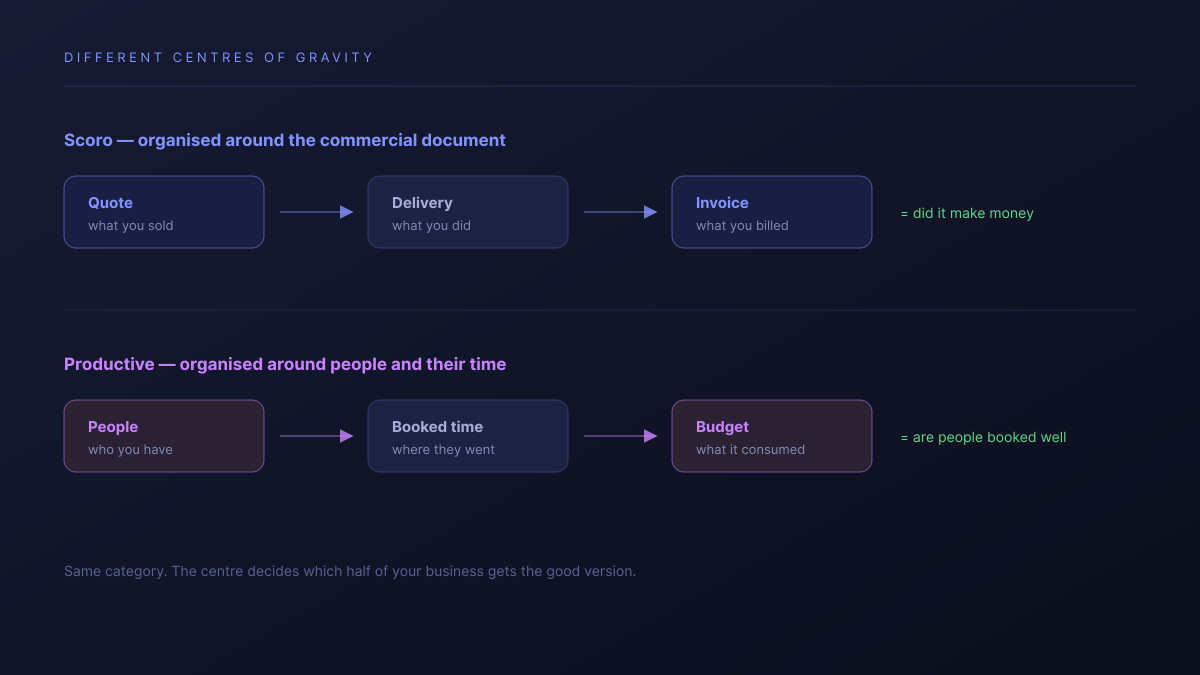
Scoro is organised around the commercial document. Work flows from a quote, through delivery, to an invoice, and the product is assembled from modules that map to those stages. Productive is organised around the person's time. Budgets and resource scheduling sit at the centre, and the money questions are answered from how people were deployed against them.
Same category, different centre of gravity. Everything below follows from that one difference.
Which question does each one answer?
Scoro answers did this job make money, from quote to invoice. Productive answers are our people profitably deployed. Both are real agency questions, most agencies have both, and almost every agency has one of them hurting more than the other right now. That is the one to buy for.
- If the pain is quoting and billing — estimates that drift from what was delivered, invoices assembled by hand at month end, no reliable read on margin per job — Scoro is aimed directly at that.
- If the pain is capacity — who is over-booked, who is idle, whether next month's pipeline is deliverable with the people you have — Productive is aimed directly at that.
- If the pain is neither and it is actually coordination, the brief and client approvals, then both of these are heavier than the problem and you should look at the general tools instead.
They are not competing answers to one question. They are good answers to two different ones, and the honest comparison is about which question is louder in your shop.
What does each cost, and what is the catch?
Both are priced well above the general project tools, which is the correct price for what they do — these are financial systems, not boards. The structural catch is different in each, and the Scoro one bites smallest agencies hardest.
Scoro requires a minimum of five users. Its pricing page states "Minimum 5 users", and that applies regardless of how many people you actually have. A three-person shop pays for five. Productive's pricing page states no minimum.
Both vendors have also restructured their plans recently — Scoro now sells modular bundles built around commercial stages rather than one flat tier ladder, and the placement of features has moved with it. Price both directly with the vendor before you commit, rather than trusting any comparison table, including the ones in our own earlier articles. Feature placement in this part of the category moves more often than in the general tools.
What is stable enough to plan around is where each vendor puts the capability you came for:
| Capability | Scoro | Productive |
|---|---|---|
| Quotes and invoicing | Core to the product, in the billing bundles | A tier above the entry plan |
| Resource scheduling | A separate bundle | In the entry plan |
| Budgets and profitability | In the billing bundles | In the entry plan |
| Retainers | In the delivery bundles | A tier above the entry plan |
| Seat minimum | Minimum 5 users | None stated |
Which one fits a smaller agency?
Productive, usually, and mostly because of the seat minimum. Below about eight people the five-user floor means a meaningful share of a small agency's software budget is paying for seats that do not exist. Productive also puts budgets and resource scheduling in its entry plan, so the capability a ten-person shop actually wants is available without climbing.
Scoro earns its keep at the other end, and earlier than you would guess if quoting is central to how you sell. An agency doing fixed-scope work with lots of estimates gets more from quote-to-cash than from utilisation charts, whatever its headcount.
What do both of them assume about how you work?
That your timesheets are true. This is the assumption to test before you buy either, because everything each tool tells you is derived from it. Utilisation, margin, budget burn, profitability by client — all of it is time entries with a different hat on.
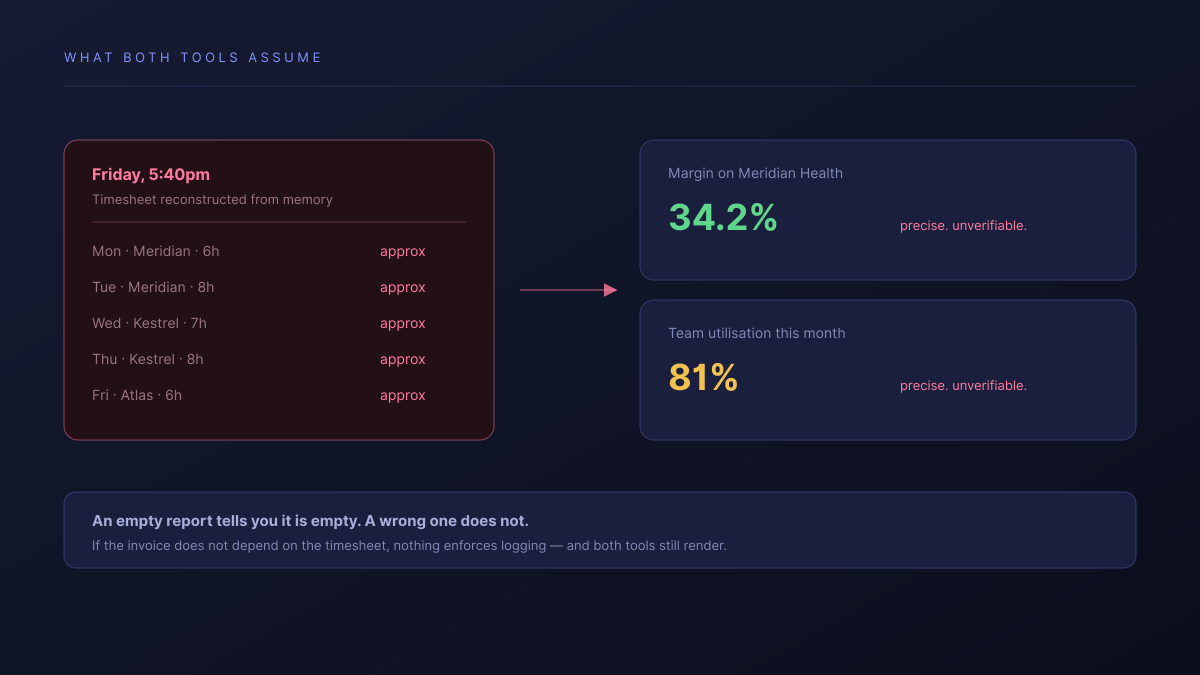
If your invoice depends on the timesheet, compliance is enforced by the invoice and the data is accurate as a side effect. If you bill fixed fees or flat retainers, nothing enforces logging, entries get reconstructed on Friday, and both tools will render confident, precise, wrong reports. We wrote about that trap at length in does your agency bill by the hour?, and it applies here with more force, because these products are more expensive and their whole value is the reporting.
Where does Atwork fit, if at all?
For most readers of this particular comparison, it does not, and saying otherwise would waste your time. If you are choosing between Scoro and Productive you have a financial-operations problem, and we do not do quote-to-cash accounting, utilisation modelling, or invoices built from logged time. Those are not roadmap items we are being coy about; they are a different product.
Where we do overlap is the layer underneath the money: the delivery work itself, the brief, the client's view of it, and the approval.
| Scoro or Productive | Atwork | |
|---|---|---|
| The question it answers | Did this make money | Is the work moving, and does the client know |
| Client contacts | A stakeholder on a project | Unlimited, never counted, scoped to their own rows |
| Seat minimum | Five on Scoro; none on Productive | None |
| Where the brief and approval live | Alongside the commercial record | On the item itself |
Plenty of agencies run one of those financial tools next to something lighter for delivery and client access, and that is a sensible arrangement rather than a compromise. The Agency CRM template is where that usually starts, and the agencies overview covers the scope.
Where both are better than us, plainly: everything to do with money. If you need to know margin per job or whether your people are profitably booked, buy one of them. We would be the wrong purchase and you would be back here in six months.
Where should you start this week?
Write down which of the two questions is costing you more right now — did this job make money, or are our people properly booked. Not both. The one you would pay to answer tomorrow.
Then ask the harder one: would the answer be trustworthy given how your team logs time today. If the honest answer is no, fix that before you buy either tool, because both of them will happily turn an unreliable timesheet into a confident report, and a wrong number is more expensive than no number.
Pick the question that is costing you more, then check whether your timesheets could answer it honestly. Fix that first, whichever tool you buy. Start free