Teamwork is one of the few tools in this category that was actually built for agencies rather than adapted for them, so most reasons people leave it are not the usual complaints about fit. The question worth answering before you shortlist anything else is narrower and more useful: what is the unit you sell? Teamwork is organised around the billable hour. If that is what you sell, it is a strong tool and the alternatives are mostly downgrades. If it is not, you are paying for machinery you will never keep current.
What is Teamwork actually built around?
Billable time. Not tasks, not boards — those are table stakes here. The spine of the product is that work gets logged against a project, hours are marked billable or non-billable, and the money side is derived from that log: budgets burn down, retainers track, and at the higher tiers invoices are built from the logged time.
That is a genuine strength and worth stating plainly. Most tools in this bracket bolt time tracking on as a column. Teamwork treats the timesheet as the source of truth and builds reporting on top of it, which is why it reads as agency-native in a way Monday or ClickUp do not.
It also gets client access right in a way its bigger competitors do not. Client users are a free licence type — Teamwork's own documentation states that client users and collaborators added to your site do not incur a cost. There is no guest seat allocation to track and no overflow charge. The one limit worth knowing: a client user can be added to up to five of their company's projects, which matters if you run more than five live workstreams for a single client.
Does your agency bill by the hour?
This one question decides most of it. Teamwork's value is proportional to how closely your revenue tracks logged hours.
| You bill by the hour | You bill fixed fee or retainer | |
|---|---|---|
| The invoice comes from | Logged hours | A price agreed before any work |
| Is the timesheet optional? | No — the invoice enforces it | Yes — nothing enforces it |
| So the reports are | Accurate as a side effect | Built on Friday-afternoon guesses |
| Which means | A time-centred tool earns its price | You bought machinery you will not keep current |
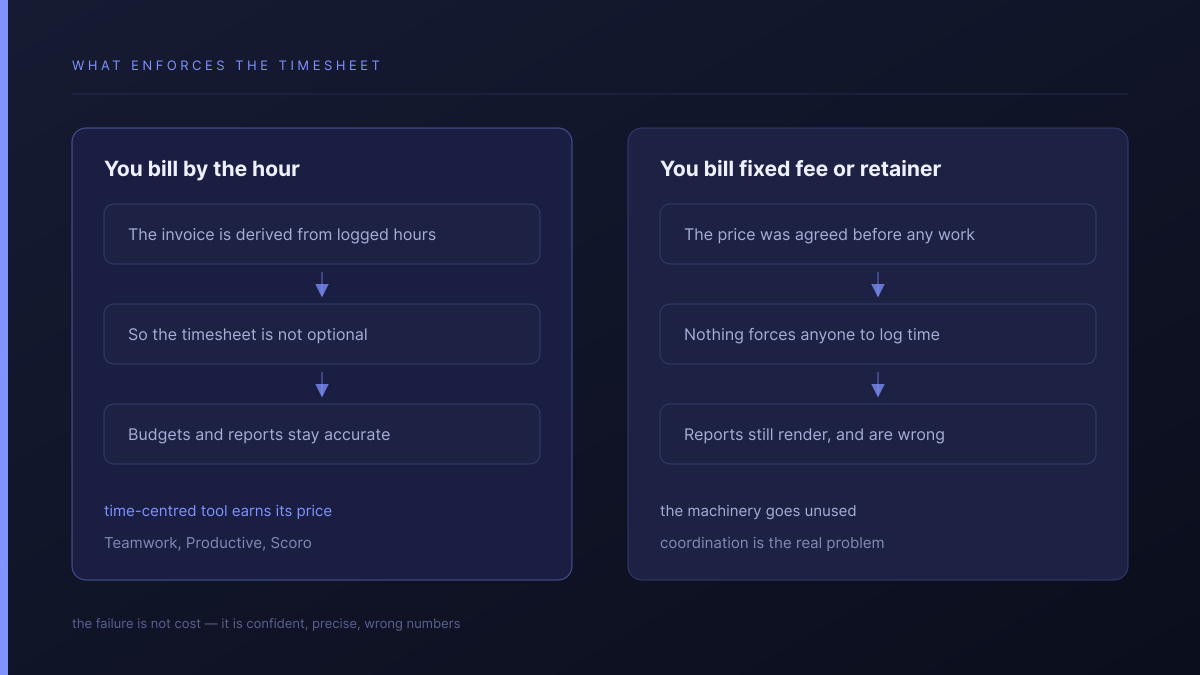
The distinction is not about size or sophistication. Plenty of twenty-person agencies bill fixed-fee and plenty of five-person shops bill hourly. It is about what your invoice is derived from.
What happens when nobody logs their time?
The reporting degrades quietly, and this is the failure mode to think hardest about. Every time-based system depends on daily compliance from people who did not join an agency to fill in timesheets. When billing depends on the log, that compliance is enforced by the invoice — the hours have to be in, so they go in.
When billing does not depend on the log, nothing enforces it. Entries arrive on Friday for the whole week, reconstructed from memory and rounded to the nearest half hour. The budget burn-down still renders. The utilisation report still produces a number. Neither is true, and because they look identical to accurate ones, decisions get made on them for months.
An empty report tells you it is empty. A wrong one does not.
So the honest risk of buying a time-centred tool without hourly billing is not that you paid too much. It is that you end up with confident, precise, wrong numbers.
What does the higher tier actually buy?
The financial half. Teamwork's pricing splits it like this:
| Basics — $9.99 | Accelerate — $24.99 | |
|---|---|---|
| Project management | Yes | Yes |
| Client users | Free, unlimited | Free, unlimited |
| Billable vs non-billable time | Yes | Yes |
| Time budgets and retainers | — | Yes |
| Client invoices from logged time | — | Yes |
| Timesheet review and approval | — | Yes |
| Seat minimum | 3 users | 5 users |
| Ten people | $100/mo | $250/mo |
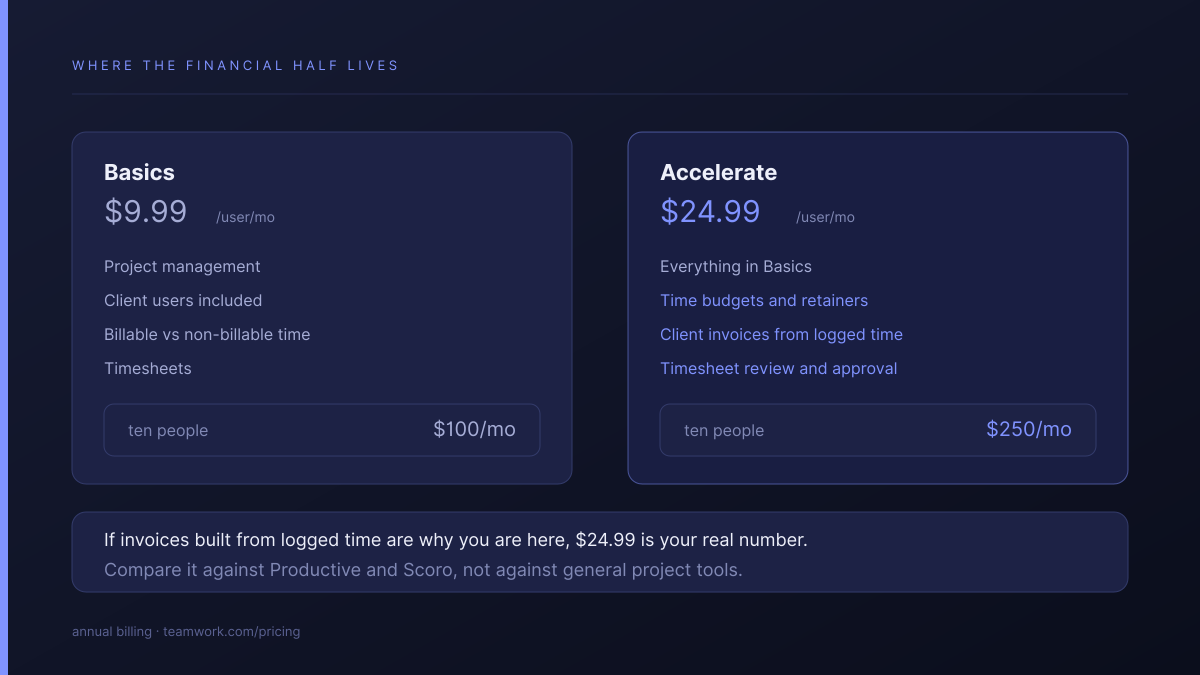
That gap is the decision in miniature. If invoices built from logged time are why you are here, Accelerate is your real number and you should compare it against Productive and Scoro rather than against general project tools. If they are not, Basics is a reasonably priced project tool with unusually good client access, and the comparison set is completely different.
Note the seat minimums, because they are easy to miss and they bite the smallest agencies hardest. Basics bills a minimum of three users and Accelerate a minimum of five. A four-person agency that needs retainers and invoicing pays for five seats at $24.99, not four — $125 a month rather than $100.
What are the real alternatives, and who is each for?
| If you want | Go with | Why |
|---|---|---|
| The financial half to go deeper | Productive | Stronger resource planning and profitability, similar tier price |
| Invoicing to be the point | Scoro | Genuine quote-to-cash — note the five-seat minimum on every plan |
| To drop the financial half entirely | Asana or ClickUp | Cheaper and broader, with guest-seat caveats |
| To solve coordination, not billing | Atwork | Covered below |
If you are still narrowing the field, the selection framework for small agencies walks through the three numbers that decide this.
How does Atwork compare?
Atwork is built around the delivery, not the timesheet.
| Teamwork | Atwork | |
|---|---|---|
| Organised around | The billable hour | The deliverable and its approval |
| Client users | Free, unlimited | Free, never counted |
| Projects per client user | Up to 5 | No limit |
| Seat minimum | 3 on Basics, 5 on Accelerate | None — three people pay for three |
| Invoices from logged time | Yes, at $24.99 | No |
| Retainer burn-down | Yes, at $24.99 | No |
| Utilisation reporting | Yes | No |
| Brief, work, feedback, sign-off | Spread across tools | On the same item |
| New client setup | Configure a project | Template installs the workspace |
Where Teamwork is better, plainly: if you bill hourly, it wins. We do not build invoices from logged time, we have no retainer burn-down, and we do not do utilisation reporting. Those are the reasons Teamwork exists, and none of them are on our roadmap as a like-for-like replacement. Swapping a working hourly-billing system for us would be a downgrade in exactly the dimension you bought it for.
Where we fit is the fixed-fee and retainer agency whose real cost is coordination — chasing approvals, rebuilding the same setup per client, answering status questions. The Agency CRM template is the usual entry point and the agencies overview covers the scope.
Where should you start?
Open your last ten invoices. If the number on them was derived from logged hours, stay with a time-centred tool and spend your effort choosing between Teamwork, Productive and Scoro on depth rather than price.
If the number was agreed in advance — a fixed fee, a flat retainer, a value price — then ask what your time data is actually for. If the answer is over-servicing checks rather than billing, you need far less timesheet machinery than you are paying for, and the coordination problem is probably the one worth solving.
Open your last ten invoices. If the number on them was agreed in advance rather than derived from logged hours, the coordination problem is the one worth solving — run one client through it for thirty days. Start free