A year-end client review is one meeting per client, held before the renewal, that looks back at the year and ends in a decision. Most guides treat it as a deck to prepare. It works better as a decision you prepare for all year: the late approvals, scope changes and quiet weeks you logged as they happened become the agenda. This guide covers the signals, the agenda, the room and the outcome, with Atwork's Client Account Reviews template.
Your client is probably running a review of its own. In Setup's Marketing Relationship Survey, 68% of clients in 2024 still planned to review their agency relationships by the end of the year. Better that yours comes first.
What is a year-end client review, and how is it different from a monthly report?
A year-end client review looks at the whole year and ends in one call: renew, change the scope, flag the account at risk, or end it. A monthly report answers whether this month worked. The review answers whether next year should happen, and on what terms, so it is built from different material.
| Monthly report | Year-end client review | |
|---|---|---|
| The question | Did this month work? | Should next year happen, and on what terms? |
| Who it is for | The day-to-day contact | The person who signs the renewal |
| Built from | This month's numbers | The year's signals, from both sides |
| Ends with | Next month's plan | One outcome: Renew, Change scope, At risk or Ending |
The review doesn't repeat the monthly client report; it reads the year.
The stakes are bigger than one year's fee. A 2025 ANA and 4As study of agency-of-record relationships puts the average client-agency tenure at about seven years, more than double the 3.2-year average reported in 2016. Frederick Reichheld of Bain & Company put the economics in one line in Loyalty Rules! (2001): "An increase in customer retention rates of 5 percent increases profits by 25 percent to 95 percent."
Which signals tell you a client is at risk before the meeting?
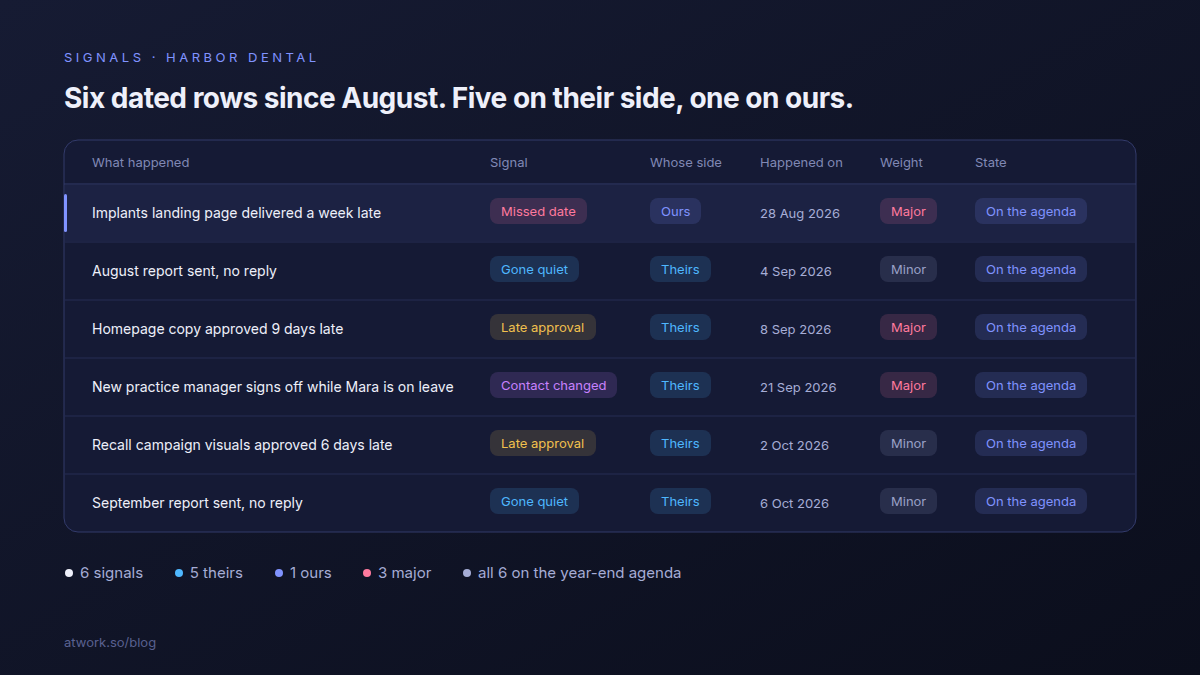
The signals that put a renewal at risk are small, dated events: an approval nine days late, a report with no reply, a new approver, an extra request absorbed, a missed date. One means little. Five in a quarter, logged with a date and a side, tell you how the renewal will go.
Agencies tend to misread them. In Setup's 2025 survey results, clients named dissatisfaction with delivery and with value as their top reasons for ending an agency relationship, each at 61%. Agencies looked elsewhere: 75% believed client budget cuts were the leading cause, and only 18% named delivery.
| Signal | What it looks like | What to ask in the review |
|---|---|---|
| Late approval | Homepage copy approved 9 days late | Who approves now? |
| Gone quiet | Two monthly reports in a row with no reply | Is the report answering their question? |
| Contact changed | A new practice manager signs off | Who signs the renewal? |
| Scope change | A second tender deck in one month, absorbed | Should this be priced? |
| Missed date | Our landing page, a week late | What do we change? |
| Praise | The founder praised the holiday campaign | What should we do more of? |
| New work asked | A quote for a packaging refresh | A project, or part of the retainer? |
Log each one the day it happens; memory keeps only the last month and the worst moment. Count your own misses too.
"Clients generally do not leave because of one bad meeting or one disappointing deliverable." Setup, on eight years of its Marketing Relationship Survey
What goes on the agenda, and what stays off?
The agenda is the year's signals in date order, then what each side changes, then next year's plan and the renewal call. What stays off is anything that proves you were busy: hours as a headline, the activity recap, a pitch for new work before the renewal is settled. The meeting exists to make a decision.
- The year in signals. In date order, as facts: "Homepage copy approved 9 days late", not "approvals were slow".
- What we got wrong. Our side first, and what we change.
- What slowed the work. Their side. Ask what would make it easier for them, not whose fault it was.
- Next year's plan. What stays, what goes, what is new.
- The renewal call. One outcome before anyone leaves the room.
Send the agenda's signals to the client a week before, yours included, so nothing in the room is news. With the signals logged, 45 minutes is enough.
- Hours as a headline. If the account is over-serviced, bring the numbers from how to tell if a retainer is actually profitable, but lead with what changed for the client.
- New work before the outcome. It goes under next year's plan, after the problems are settled.
Who should be in the room on each side?
A year-end client review needs two people from each side. Yours: the account lead and the person who runs the work day to day. Theirs: whoever signs the renewal and whoever approves the work. When those are two people, invite both: the approver knows what slowed the work, and the signer decides whether next year happens.
A Contact changed signal changes the guest list: a new practice manager who has signed off since September belongs in the room. People changes cut both ways. In Setup's 2025 results, 35% of clients named a change in client leadership as a reason a relationship ended, and 28% a change in agency personnel. Not sure who signs? Put it on the client record first, as in the agency client database.
How do you turn the review into a renewal or a scope change?
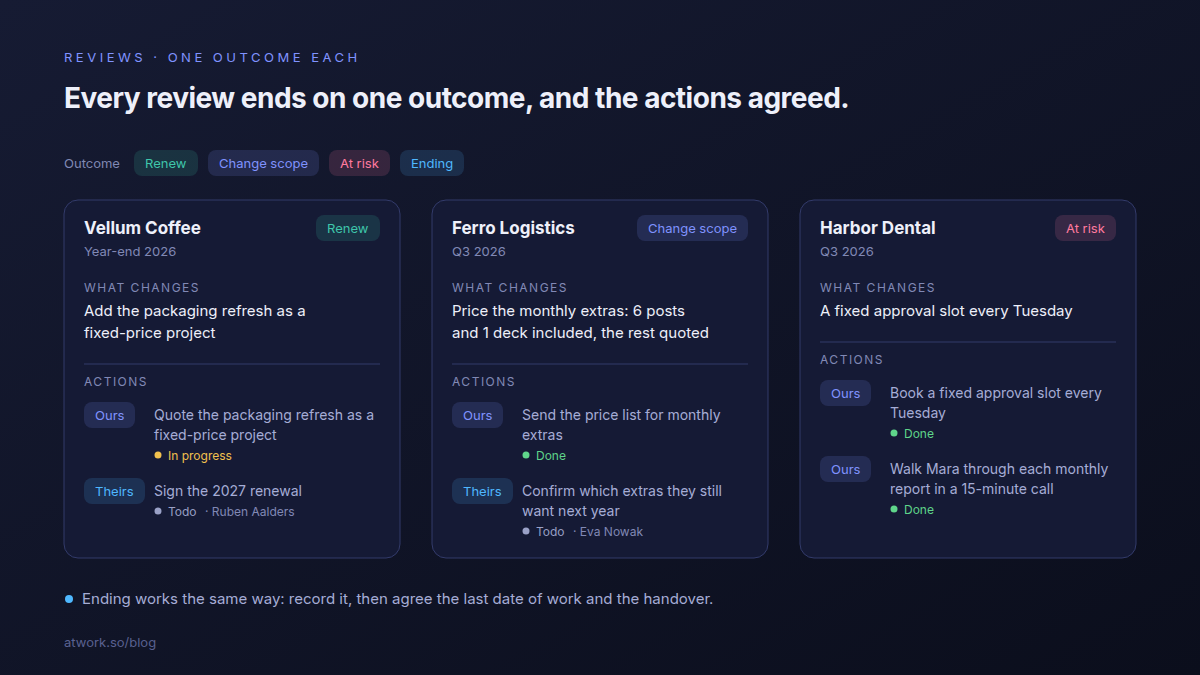
A review turns into a renewal or a scope change when it ends on one of four outcomes, decided in the room: Renew, Change scope, At risk or Ending. Write what changes in one line, add actions for both sides with an owner and a date, and send a one-page summary within two days.
When the answer is Change scope
A scope change that keeps the client beats a renewal nobody believes in. Take Harbor Dental, the example account in the template: six signals since August, five on their side and one on ours. The proposal is to drop paid social and take the fee from €4,200 to €3,400 a month. That is €9,600 a year less, against €50,400 a year if the account ends. Ferro Logistics went the same way after three absorbed requests, and the extras are now priced; scope creep: the change request nobody sends covers logging them.
When the answer is At risk
At risk is an outcome, not a verdict. Agree the actions that would change it, with an owner on each side: ours might be a fixed approval slot every Tuesday, theirs naming who approves while the main contact is away. Check them before the notice date, which retainer renewal reminders count back from.
How do you set it up with the Client Account Reviews template?
To run reviews with Atwork's Client Account Reviews template, install it, add one row per client with its renewal date, and log signals as they happen. Each review is a task with the agenda in its description, an Outcome and the actions for both sides. A workflow adds a Pre-renewal review 60 days before each renewal date.
- Install Client Account Reviews. It installs into any workspace.
- On Clients, fill in each account's Renewal date and Renewal outlook (Likely, Unsure or At risk).
- On Signals, add a row the day something happens, with Whose side it was on.
- Open Workflows on the Clients sheet, open Renewal review reminder and click Publish.
- Before each review, set the signals you will raise to On the agenda and link them in Raised in.
- After it, set the Outcome, write What changes and add the Actions for both sides.
A chart of monthly fees by renewal outlook shows how much sits in Unsure and At risk before the first review is booked. For hours sold against hours delivered, pair it with Retainer Management & Utilisation.
Frequently asked questions
How far before the renewal date should you hold it?
At least 60 days, and earlier when the contract has a notice period: count back from the last day either side can give notice, so there is still time to act on the outcome.
Is a year-end review the same as a QBR?
A quarterly business review (QBR) is the same meeting on a shorter cycle. The template's Reviews sheet takes Quarterly, Year-end and Pre-renewal reviews, so a quarterly client gets three short reviews and one that decides the renewal.
What if the outcome is Ending?
Record it, agree the last date of work and the handover, and add the actions for both sides. An ending you planned for costs less than one you discover when the invoice stops.
Where should you start this week?
Pick the client that renews first. Go through last quarter's email and log every signal you can date: approvals, reports with no reply, requests you absorbed, dates you missed. If there are more than five, book the review now, before the client books theirs.
Install Client Account Reviews, add the client that renews next, and log this quarter's signals before you book the meeting. Start free