Handover happens at the worst possible moment: someone is leaving, everyone is busy, and the response is to ask the person walking out of the door to write down everything they know. They cannot. Not because they are unwilling, but because most of what makes them good at the account stopped feeling like knowledge years ago.
Why do handover documents miss the things that matter?
Because they capture what is findable and omit what is remembered. File locations, logins, the timeline and the contact list all go in — and every one of those could have been discovered without asking anyone. The expensive knowledge is the kind that only shows up when you are about to get something wrong.
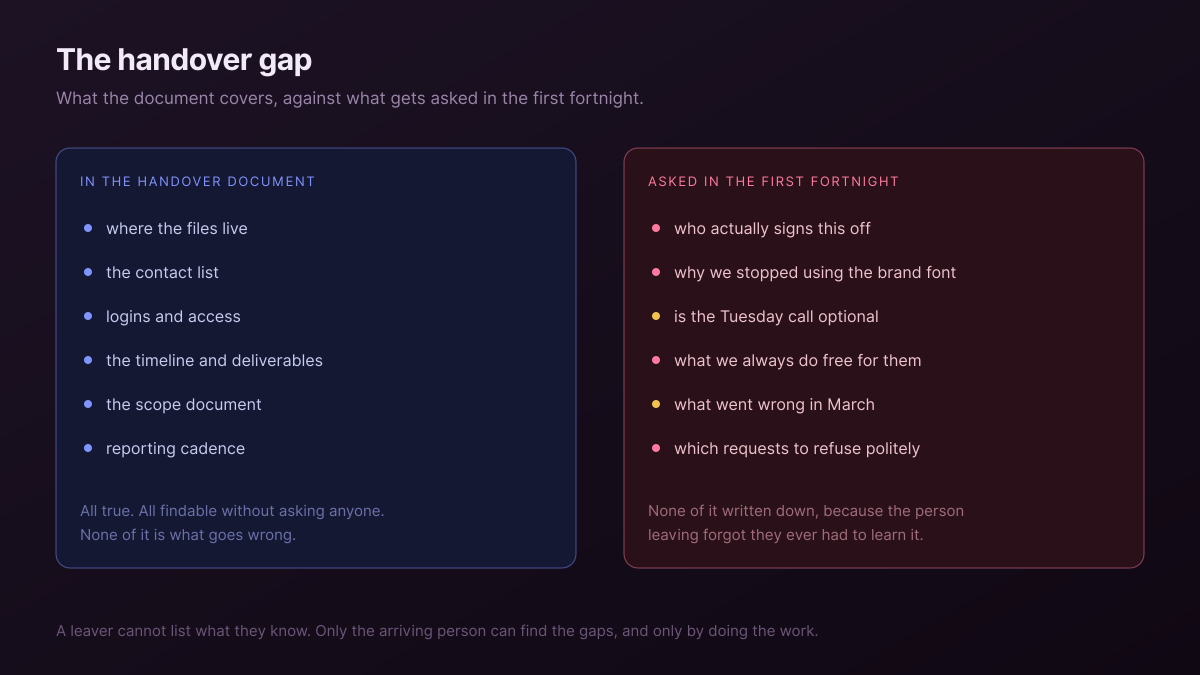
The asymmetry is structural. A leaver writing a document works from what they can recall being told. The arriving person needs what nobody ever told anyone — that this client's marketing director signs off in practice even though procurement signs off on paper, that the Tuesday call has been optional since March, that you always redo their spreadsheet formatting and have never once billed for it.
Ask someone to write down what they know and you get the contents of the shared drive. The valuable part is what they have stopped noticing they know.
What actually transfers the knowledge?
Doing the work while the other person is still there. One full delivery cycle — a sprint, a month, a campaign, whatever the repeating unit is on that account — watched, then run with support, then owned. The questions surface because the work surfaces them, in an order no document can predict.
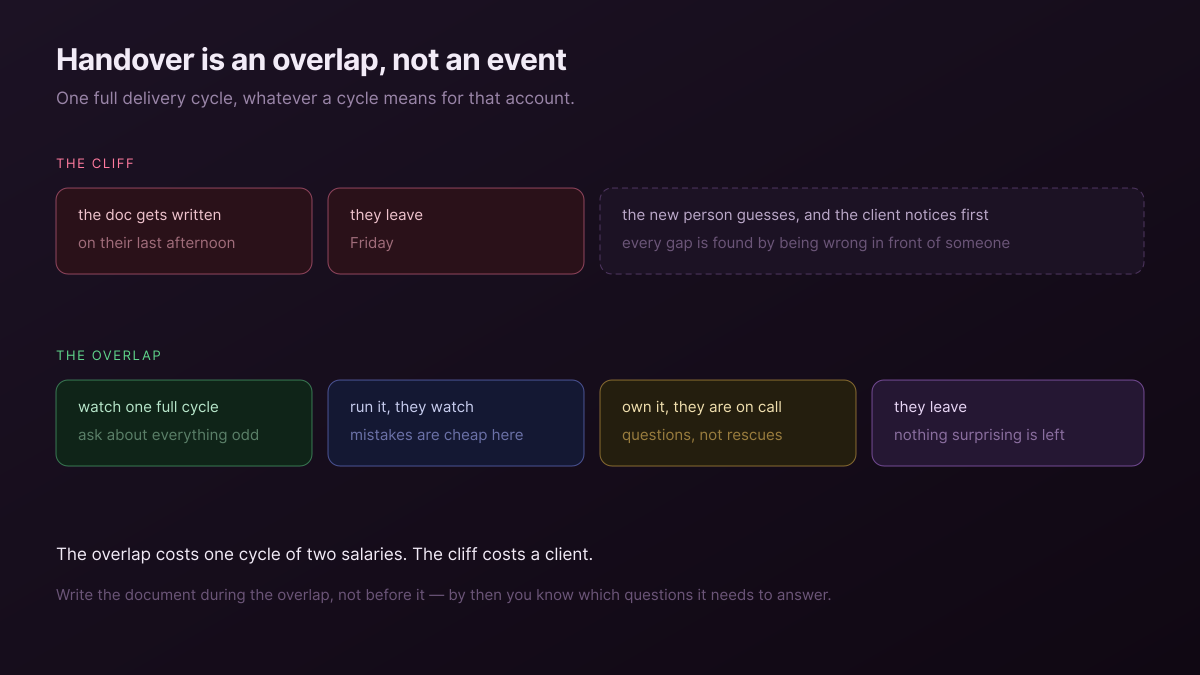
The sequence matters more than the length. Watching first gives the arriving person the vocabulary to ask anything at all; running it second makes their mistakes cheap, because the person who knows is sitting there; owning it third, with the leaver reachable, converts rescues into questions.
- Watch one full cycle. The instruction is to ask about everything that looks odd, because odd things are where undocumented decisions live.
- Run it while they watch. This is where the gaps appear, and they appear safely.
- Own it while they are on call. Reachable, not responsible — the distinction keeps both people honest.
- Then they leave, and nothing left is a surprise.
When should the document get written?
During the overlap, by the person arriving. This inverts the usual order, and it is the single change that makes handover documents worth having, because the arriving person is the only one who knows which questions needed answering.
A document written by the leaver is a list of what they thought was important. A document written by the arriver during their first cycle is a list of what actually tripped someone up. The second is shorter, more useful, and gets maintained, because the person who wrote it is the person who needs it.
What if there is no time for an overlap?
Then shorten it rather than skipping it, and be clear-eyed about what you are buying. Two weeks of overlap costs two weeks of one salary. Losing the account costs the account, and a rocky handover is one of the more common reasons agencies lose one.
When the overlap genuinely cannot happen — someone left abruptly, or the notice period is gone — the fallback is not a longer document. It is telling the client. A client who knows there has been a change will forgive a question they would not forgive a mistake about, and the questions you need to ask are exactly the ones that reveal the change anyway.
| Dimension | A handover document | Atwork |
|---|---|---|
| Where the decisions live | In someone's memory, then a doc | On the items, as they were made |
| Written when | On the last afternoon | Continuously, as work happens |
| What it covers | What the leaver recalled | What the work actually required |
| Findable at the moment of need | Only if you know it exists | It is attached to the task in front of you |
| Replaces an overlap | No | No — nothing does |
How do you stop the knowledge leaving in the first place?
Put the decisions on the work while they are being made, rather than trying to extract them afterwards. If the reason a deliverable looks the way it does is written on the item, the handover for that decision has already happened and nobody had to remember to do it.
This is the quiet argument for keeping the thread and the brief on the task rather than in email. Email is a record only the participants can search; the item is a record the next person inherits automatically. How to structure an agency workspace covers where that should sit, and status updates without the weekly call covers keeping the client side of it visible.
The standing favours are worth particular attention, because they are invisible and expensive. If your team always does something free for a client, write it down as a thing you do — otherwise the new person either stops doing it and looks worse than their predecessor, or keeps doing it without ever knowing it was optional. How to stop over-servicing retainer clients covers how to find them.
Where should you start this week?
Pick the account with the highest bus factor — the one where a single person's absence would be felt hardest — and ask that person one question: what do you do for this client that is not written down anywhere? Write the answers on the account, not in a document.
That list is your handover risk, and it takes twenty minutes to produce. Most agencies are surprised by how short it is and how load-bearing every line turns out to be.
The Agency Client Delivery template ships the structure this lives in, and the agencies overview covers the wider setup.
Ask your most indispensable person what they do that is not written down. Put the answers on the account today. Start free