Teams that adopt AI agents often already have automations running, and the two overlap enough to cause genuine confusion. Both react to something happening. Both do work without a person. Both are described in the marketing as saving time on repetitive tasks.
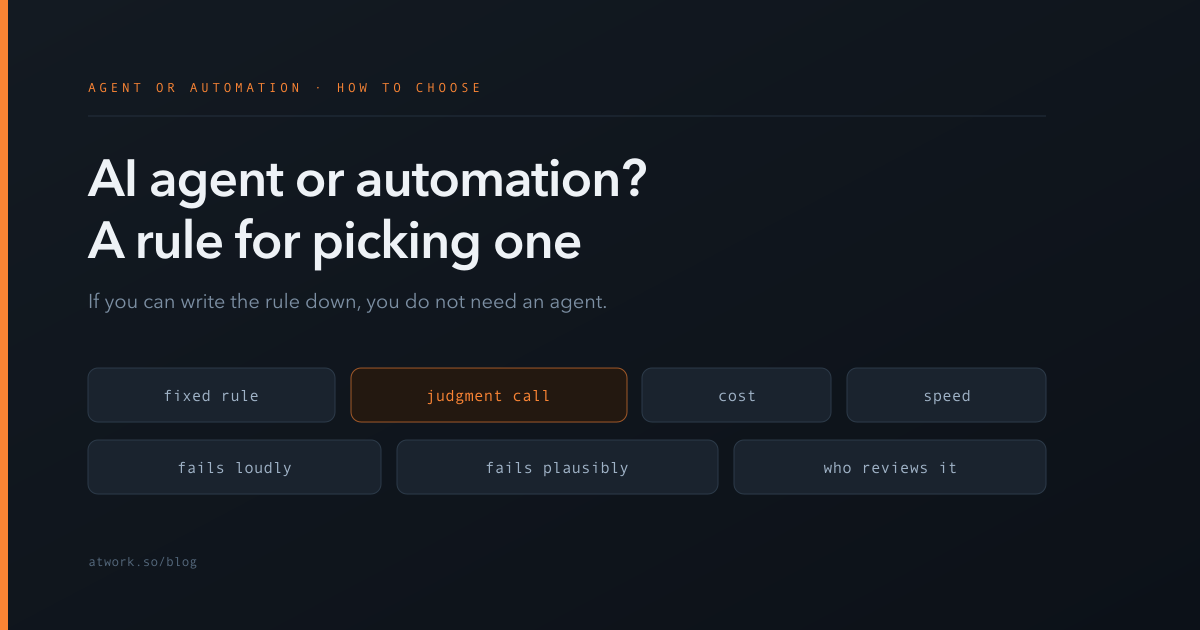
The rule for choosing is short: if you can write the rule down, use an automation. If writing the rule down would take a paragraph of judgment, use an agent.
Everything below is an elaboration of that sentence.
What is the actual difference between them?
An automation follows instructions. An agent forms an opinion.
An automation is deterministic. Given the same input it produces the same output, every time, forever. When a deal moves to Won, notify the account manager and create an onboarding task. There is no interpretation involved, which is exactly why it is trustworthy.
An agent is probabilistic. It reads the situation and decides what to do within the boundaries you set. Read this support request and set a priority. Two similar requests might get different priorities, because the agent is exercising judgment rather than matching a pattern — which is the entire point, and also the entire risk. (If the word agent is doing unfamiliar work in that sentence, here is what one actually is in Atwork.)
So the question is never which is better. It is whether the task you have in mind requires judgment. Most tasks that feel like they need AI turn out, on inspection, to be rules nobody has bothered to write down.
How do they compare on the things that matter?
Six dimensions separate them, and the last two are the ones people underweight.
- Consistency. An automation returns the same output for the same input, always. An agent offers no such guarantee.
- Unanticipated cases. An automation either does nothing or does the wrong thing. An agent usually copes reasonably.
- Cost per run. Negligible for an automation. Real for an agent, and it scales with volume — which is why the model tier you pick matters more than it looks.
- Speed. Instant, versus seconds to minutes.
- How it fails. An automation fails loudly — it stops, or does something obviously wrong. An agent fails quietly, producing plausible output that happens to be incorrect.
- Review burden. An automation rarely needs checking. An agent does, at least until you have calibrated it.
Those last two are worth dwelling on. An automation that breaks announces itself: the task did not get created, the notification never arrived, someone complains within a day. An agent that goes subtly wrong produces something that looks right, gets accepted, and is discovered three weeks later.
That asymmetry should make you biased toward automations wherever both would work.
When is an automation clearly the right answer?
When the logic can be stated as conditions and actions, without the word appropriate or relevant appearing anywhere in the description.
Strong automation candidates:
- Notifying someone when a field changes
- Creating a follow-up task when a status reaches a certain point
- Moving an item between views or spaces based on a value
- Sending a scheduled digest
- Enforcing a rule — every item entering this status must have an owner
If you find yourself writing an automation with fifteen branches to handle every case, that is a signal you have crossed into judgment territory. But the answer there is often to simplify the process, not to reach for an agent.
When is an agent clearly the right answer?
When the input is unstructured language and the output requires understanding it.
Strong agent candidates:
- Summarising a long thread, a document, or a stalled deal
- Categorising free-text input where the categories require interpretation
- Drafting anything — a reply, release notes, a description
- Extracting structure from prose someone typed in a hurry
- Answering questions across a body of work nobody has read recently
What these share: no rule exists that would produce a good answer. You could not write the summary logic as conditions if you tried, because summarising is judgment.
Can you use both together?
Yes, and the combination is usually better than either alone. The pattern that works is: automation for the plumbing, agent for the thinking.
A support flow, for example. An automation catches the new request, stamps it, and routes it to the right sheet — deterministic, instant, free. Then an agent reads it and produces the summary and suggested priority — judgment, worth paying for. Then another automation notifies the on-call person once the agent has finished. The triage agent walkthrough builds exactly this middle step.
Notice which parts are which. Nothing about moving a record between places requires intelligence, and paying an AI model to do it is both slower and less reliable than a rule. Reserve the agent for the one step where reading and understanding is actually required.
What is the most common mistake?
Using an agent for something with a correct answer.
If there is exactly one right output for a given input — a calculation, a lookup, a formatting change, a routing decision based on a field value — an agent is the wrong tool no matter how convenient it feels. It will be right most of the time, which is worse than a rule that is right all of the time, because the failures are unpredictable and hard to spot.
The second most common mistake is the reverse: building an automation with a growing pile of conditions to approximate judgment. That produces a rule that is technically deterministic and reliably wrong on the cases nobody enumerated.
A quick test for either mistake. Ask: could a new colleague follow written instructions to do this, with no experience? If yes, automate it. If they would need to have read a few hundred of these before doing it well, that is judgment — and that is where an agent belongs.
Where to start
List the recurring work your team does by hand. Sort it into two columns using the question above. You will usually find the automation column is longer than expected, and that the agent column has two or three genuinely good candidates on it.
Build the automations first — they are cheaper, faster and more reliable, and the first one takes about ten minutes. Then give the best agent candidate a narrow persona and a week of your attention; writing that persona well is most of the job.
Start free and build both in the same workspace, on the same board.