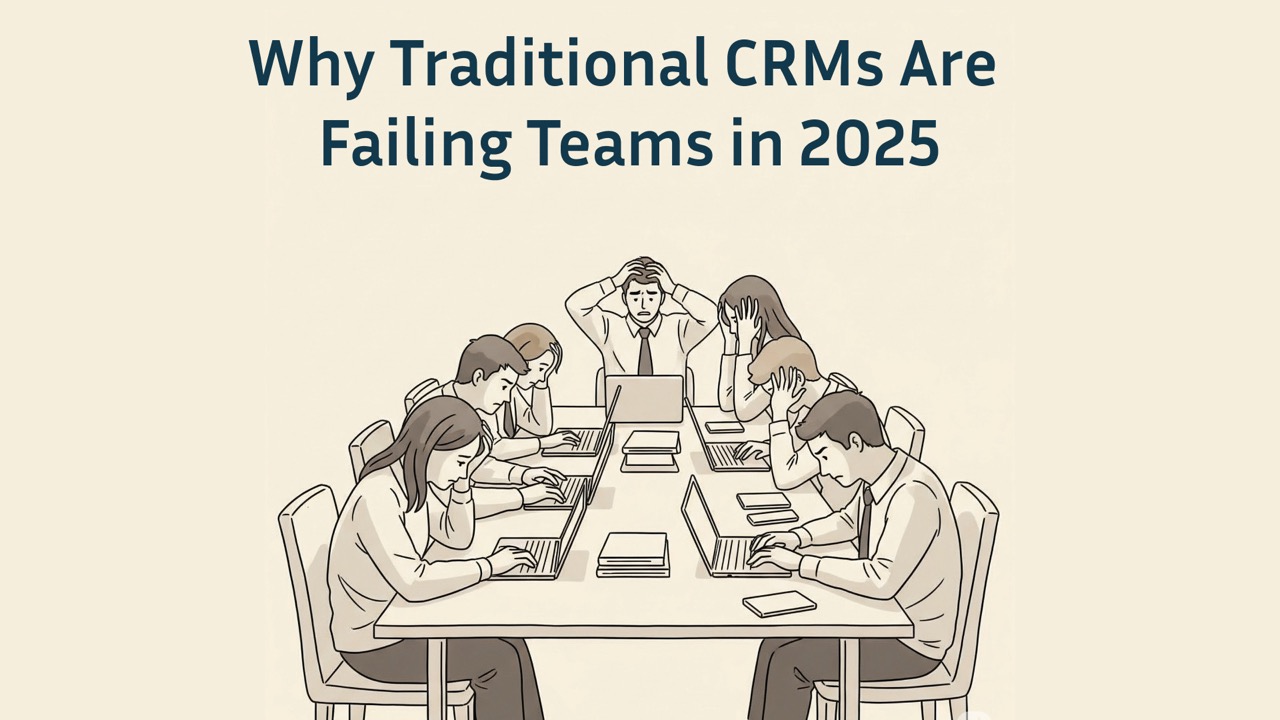
The old CRM model is broken, and modern businesses know it.
Customer Relationship Management (CRM) systems were once game-changing tools. They promised a centralized place to store contacts, manage deals, and improve team collaboration. But fast forward to today, and many teams feel like their CRM is just another bottleneck.
The truth is: traditional CRMs are failing modern teams.
Here’s why—and what businesses are doing instead.
⚙️ 1. They’re Built Around Old-School Processes
Traditional CRMs were built during a time when:
- Sales teams followed linear, one-size-fits-all pipelines
- Marketing operated in isolation
- Customer relationships were mostly transactional
But modern businesses are more agile, cross-functional, and data-driven. They need CRMs that reflect reality, not rigid pipelines or outdated assumptions.
📌 Modern teams need CRMs that mold to their workflow, not the other way around.
🧱 2. They’re Too Rigid and Hard to Customize
One of the biggest complaints about legacy CRMs? Customization is a pain.
Want to add a new field? Change your sales stages? Create a view for your customer success team?
That usually means:
- Waiting on admin access
- Learning a complex interface
- Submitting a ticket to your “CRM manager”
- Or worse—hiring a consultant
In contrast, modern teams demand no-code tools that allow them to adapt instantly. They want to iterate, experiment, and grow—without waiting on IT.
😩 3. They’re Too Complex for What You Actually Need
Traditional CRMs often suffer from feature bloat. You sign up to track leads and follow-ups. But suddenly you’re faced with:
- Endless tabs
- Unused modules
- Complex permission settings
- Confusing dashboards
- Clunky workflows
And what happens? Your team avoids using it. Leads fall through the cracks. Tasks get missed. Adoption drops. And the CRM becomes a glorified address book.
🔁 Complexity kills productivity.
🧠 4. They Lack Real Intelligence and Context
Modern work is fast-paced. Teams expect tools that think with them, not just store data.
But most legacy CRMs:
- Don’t help you make decisions
- Don’t show patterns unless you build complex reports
- Don’t proactively surface insights or follow-ups
- Don’t use AI unless you pay for expensive add-ons
Meanwhile, modern CRMs like Atwork are built with AI agents baked in—so your system:
- Suggests insights
- Summarizes pipelines
- Automates content
- Highlights risks
📊 It’s not about storing data. It’s about making it actionable.
🔌 5. Integration Is Still a Nightmare
Legacy CRMs promise “integrations,” but here’s what that often means:
- Hiring a developer
- Paying for third-party connectors
- Wrestling with APIs
- Manually syncing spreadsheets
Today’s teams use dozens of tools—email, Slack, Google Sheets, Trello, Notion, payment systems, customer support tools, and more.
They need a CRM that:
- Works where they already work
- Connects easily through no-code platforms like Make or Zapier
- Automates across workflows—not just sales
🤝 Your CRM should be a hub, not a silo.
💰 6. They’re Expensive, Especially as You Scale
Traditional CRMs may start cheap, but costs quickly pile up:
- Extra users
- Add-ons
- Integrations
- Advanced analytics
- Support tiers
And by the time you’ve built the setup you actually need… You’re locked into a bloated, overpriced system that slows your team down.
💡 Modern CRMs prioritize simplicity, transparency, and value.
🚀 The Shift: From CRM Software to Work Systems
The modern team isn’t just managing contacts. They’re running projects, building workflows, tracking deliverables, and using automation to stay ahead.
They need more than a traditional CRM.
They need:
- A flexible workspace
- A customizable database
- A visual pipeline
- A place to assign tasks and collaborate
- AI Agents that can help execute
- Automation that saves hours per week
In other words, they need a Work OS with CRM capabilities. Like Atwork.
✅ What Modern Teams Are Doing Instead
Teams are switching to modern CRMs like Atwork that are:
- No-code and flexible
- Built with AI at the core
- Fast to implement and easy to scale
- Designed for full-team collaboration
- More affordable and transparent
With Atwork, you can:
- Install a CRM template instantly
- Customize everything without developers
- Add automation and AI assistants in minutes
- Connect it to all your tools
- Expand beyond CRM—into HR, task management, forms, analytics, and more
💬 Final Thoughts: Don’t Let Your CRM Hold You Back
Your CRM should be a growth engine, not a blocker. If it’s slowing your team down, it’s time for something better.
🧠 Modern work needs modern tools. Try Atwork and experience the difference.